The office of 2050 will look very different from today: long daily commutes, the idea of a single central headquarters, and the traditional 9-to-5 could be left behind in the next 25 years, as companies are already pushing hard in that direction. This conclusion comes from the study “IWG’s Work Reimagined: The Office of 2050,” produced by International Workplace Group (IWG).
According to the report, nearly seven in ten HR leaders and employees believe long commutes and the traditional workday will disappear by 2050, with 69% and 68%, respectively. Instead, work will increasingly unfold across a network of locations, rather than relying on a single central office.
This transformation sits within a broader evolution of the office. In another IWG report, produced to mark the 300th anniversary of the modern office, CEOs identify artificial intelligence as the most influential office innovation of the last three centuries, ahead of laptops, video calls, Wi‑Fi and hybrid work.
Technology will be one of the main engines of this change. Brain implants capable of connecting the human brain directly to external devices stand out as the leading emerging technology that HR leaders and employees expect to see in the 2050 workplace, with 33% and 26%, respectively. At the same time, AI, automation and immersive technologies will redefine how we collaborate, learn and make decisions.
AI and Immersive Technologies Will Transform the Way We Work
Both HR leaders and employees believe that AI and automation will redefine the majority of office roles, with 71% and 73%, respectively. Around two-thirds also think that AI will determine the optimal place and time to collaborate, with 69% of leaders and 64% of employees.
AI-powered training will also accelerate learning, both in the classroom and at the university or on the job. As a result, employees and HR leaders expect the speed of work to rise significantly over the coming decades, with 74% and 70%, respectively.
Farewell to Long Commutes and the Traditional Workday
Work will be delivered increasingly through a network of locations. Seventy percent of HR leaders say work will take place at multiple locations, a figure that rises to 75% among employees. In addition, 64% of employees expect hybrid work to become the standard model, a share that climbs to 78% among HR leaders.
Both employees and leaders agree that strict mandates to return to the office will fade by 2050 as organizations prioritize flexibility and worker autonomy, with 66% of employees and 63% of HR leaders agreeing.
Smarter Environments and Integration Between People and Technology
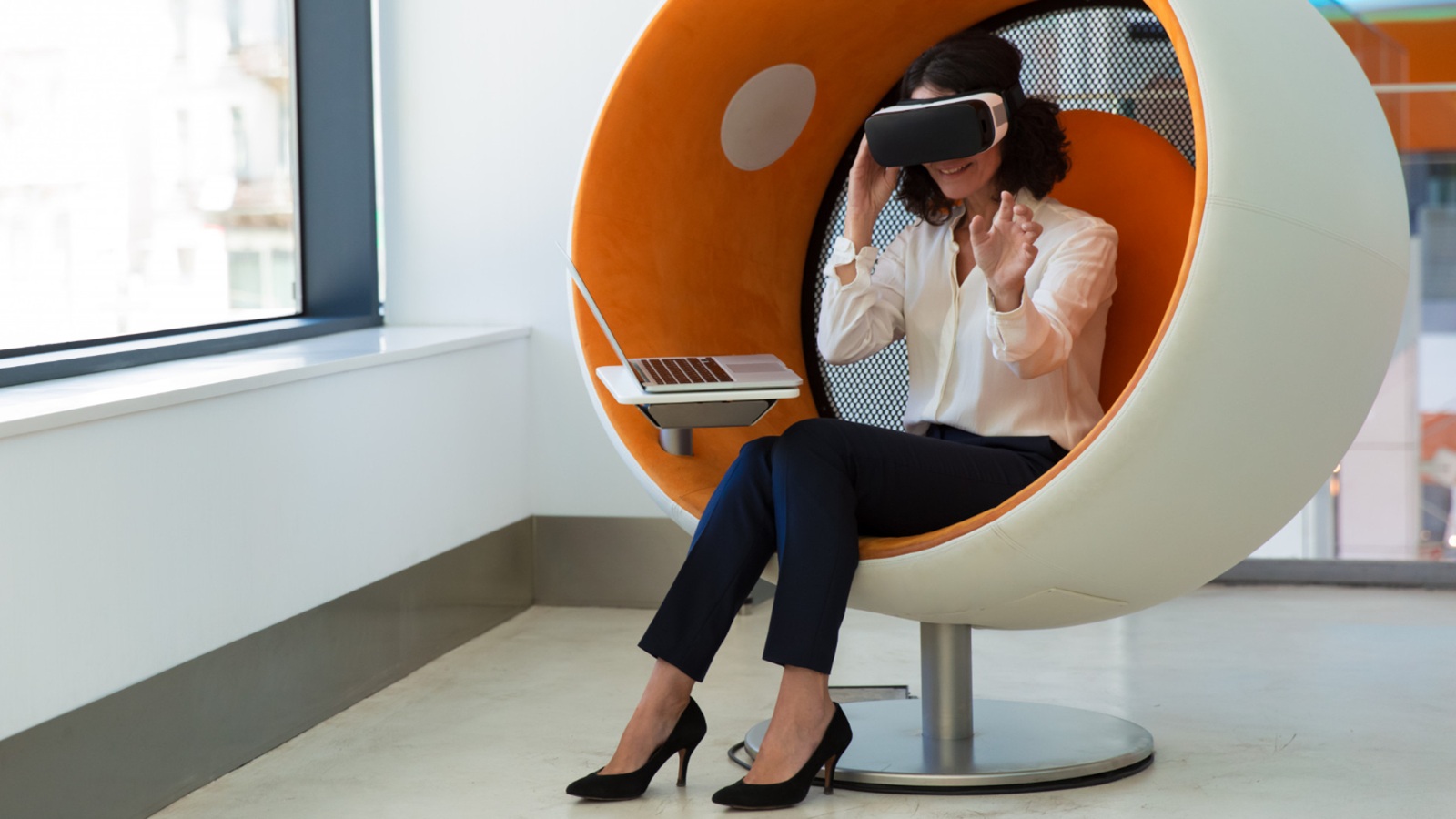
Beyond neurotechnology, immersive collaboration tools are expected to play a central role in future workplaces. Virtual reality and augmented reality meeting rooms that blend on-site and remote workers are ranked as the second-most anticipated innovation. Nearly seven in ten HR leaders and employees expect these technologies to replace many traditional office interactions, from desk-side conversations to in-person meetings, at 70% and 69%, respectively.
According to employees, workplaces will also be more responsive and aligned with human needs. They foresee automatic lighting and environmental adjustments to match individuals’ biological rhythms (28%); systems that detect fatigue and suggest rest or recovery (30%); and cloud-connected interactive spaces, with walls acting as digital touch surfaces (24%).
The Office of the Future: Flexible, People-Centered, and Nature-Connected
Although technology will transform the way we work, future spaces are expected to be more people-centered and wellness-focused. Among the most popular concepts are family-friendly spaces with childcare areas, cited by 23% of leaders and 30% of employees; as well as multifunctional environments for work, learning, socializing and resting, at 23% and 30%, respectively.
Many also envision offices designed around nature, with living walls, indoor gardens and abundant natural light, according to 22% of leaders and 28% of employees.
Looking ahead, flexibility is expected to be a decisive factor in attracting and retaining talent. Three-quarters of HR leaders and employees believe it will be essential for organizations by 2050, as workers place increasing value on work-life balance and well-being, with 75% in both groups.
Mark Dixon, CEO and founder of International Workplace Group plc, noted: “Technology has always shaped how we work, but the difference today is the speed of change. Advances in AI are accelerating the workplace at a pace many organizations are still trying to absorb. We are facing the most significant innovation curve in six decades. Technologies like AI and neurotechnology are driving us toward a future where work is faster and more intuitive. This exponential shift not only changes jobs but also changes the very velocity of business.”