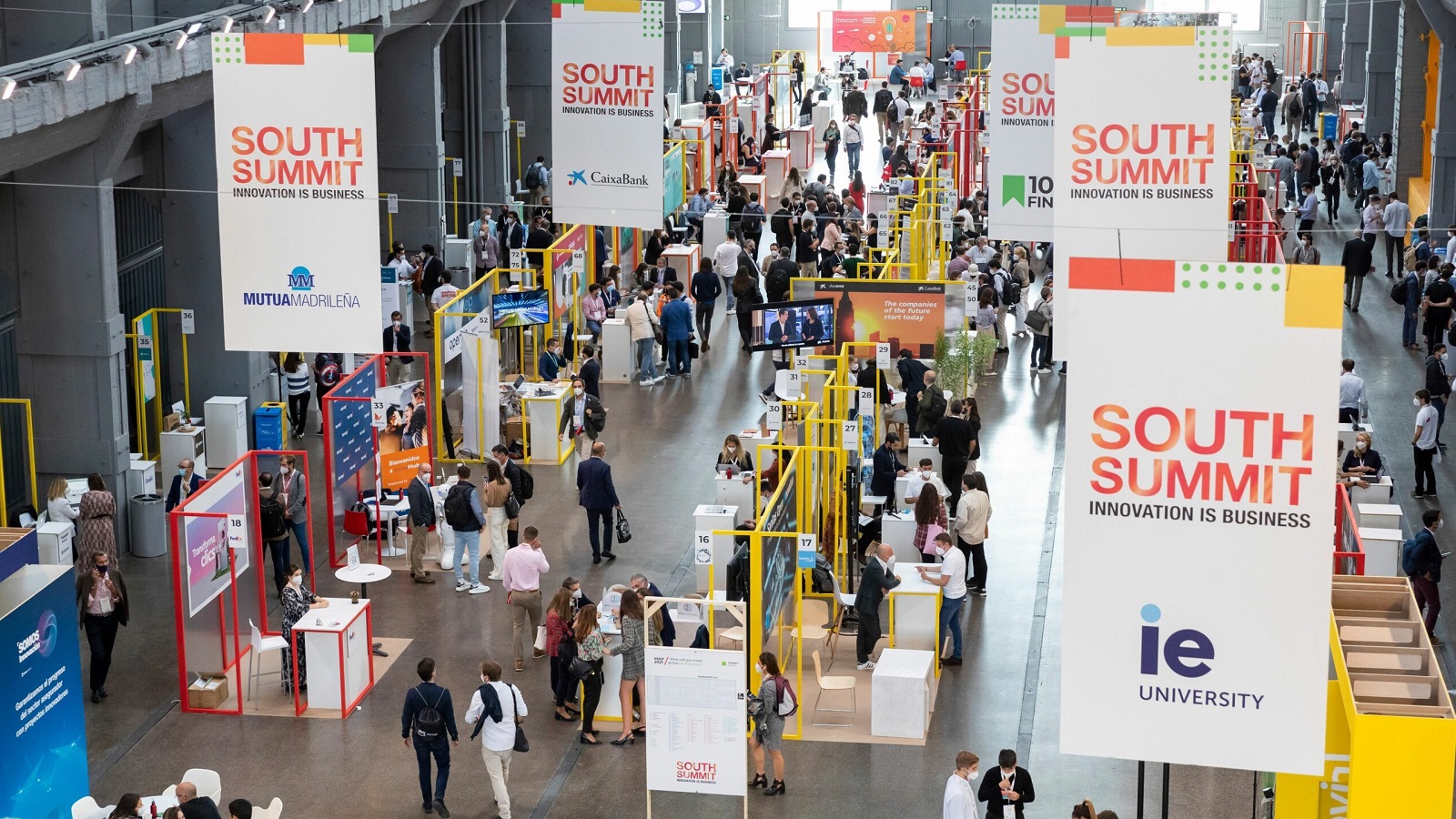
The South Summit Madrid 2027 event recently opened the registration period for its Startup Competition, the competition that each year selects the 100 most disruptive and innovative startups in the market. The 2027 edition arrives with two major changes: it expands its reach to up to 50 semifinalists and debuts a vertical structure designed for the areas that today concentrate the greatest technological growth, from AI agents to defense or frontier technologies. Interested entrepreneurs can submit their application until January 31, 2027.
A panel of judges made up of prominent investors and international experts from the entrepreneurial ecosystem will select the 100 finalist startups from all submitted entries. These teams will compete for the title of global winner of the sixteenth edition of the event.
The big novelty of this edition is the inclusion of up to 50 semifinalist startups, chosen by the jury in the same selection process, which will participate in South Summit Madrid alongside the finalists. In this way, up to 150 startups will have a presence at the event. The semifinalists will enjoy similar advantages to the finalists, such as VIP access to investors and training sessions, and will be able to present their project via a pitch on a secondary stage.
Ten verticals for the technologies that set the agenda
The Startup Competition of South Summit Madrid 2027 will feature 10 verticals grouped into six broad content blocks. In addition to the areas already present in the competition, it includes dedicated spaces for frontier technologies such as autonomous AI agents, defense and drones, quantum computing, semiconductors, longevity, and neurotechnology.
The first group, Applied AI, will bring together projects applying Artificial Intelligence to business environments through two verticals: Applied AI & Enterprise Software, aimed at B2B software applying AI to operations, sales, customer service or data analysis, and AI Agents & Automation, focused on autonomous agents capable of performing tasks, coordinating processes and automating workflows.
Infrastructure & Energy will group solutions tied to energy transformation and new infrastructures. It includes Energy, Climate & Agrifood, geared toward energy, decarbonization, water, climate adaptation, agriculture and food, and Mobility, Smart Cities & Infrastructure, focused on transportation, logistics, buildings and intelligent cities and infrastructures.
Deeptech & Dual Use will gather projects with a high technological and scientific component. Frontier Tech & Advanced Industry will cover robotics, advanced manufacturing, new materials, semiconductors and quantum computing, while Defence, Space & Dual Use will be aimed at defense, drones and space projects with both civilian and strategic applications.
The Industry Impact group will be oriented toward sectors where technological innovation has a direct impact on economic and social activity. It will include Health & Life Sciences, covering digital health, diagnostics, medical devices, biotechnology, longevity and neurotechnology, and Fintech & Insurtech, focused on payments, financial services, insurance, digital assets and financial infrastructure.
As for Trust & Governance, it will include the vertical Cybersecurity & Digital Trust, which will bring together cybersecurity, digital identity, privacy and verification projects, as well as tools for reliable AI. Finally, Talent & Culture will include the vertical Education, Talent & Future of Work, dedicated to edtech, lifelong learning, talent recruitment and development and new work tools.
From finalists to ecosystem benchmarks
With these new categories, South Summit adapts its Startup Competition to the new challenges and opportunities of the entrepreneurial ecosystem and makes room for projects linked to some of the areas with the greatest technological growth. In recent years, South Summit has established itself as an international showcase that connects entrepreneurial projects with investment and business opportunities. The more than 1,500 startup finalists in its history have raised over 22.2 billion euros in funding rounds and maintain a survival rate above 85%.
Among the most notable recent cases is Mitiga Solutions, winner of South Summit Madrid 2026. This spin-off from the Barcelona Supercomputing Center, which combines AI and supercomputing to anticipate the physical risks of climate change, has closed a multimillion-dollar deal with Multiverse Computing, which will license its EarthScan platform, distribute it through its client and partner network and serve as a technology advisor to scale its solutions globally.
Also stands out Kreios Space, a finalist in 2024. The Galician startup is developing satellites capable of operating in very low Earth orbit using the atmosphere itself as a propellant, a technology with applications in defense, connectivity and Earth observation. In 2025 it closed a round of 8 million euros led by NATO’s Innovation Fund and Join Capital, and is preparing the launch of its first satellite, scheduled for 2027.
Joining them is the Murcian company NaviLens, winner in 2024 of the Mobility & Smart Cities vertical and the award for the most sustainable startup. Its code system, which enables people with visual impairments to orient themselves and access information from their mobile, is present in more than 30 countries, and Banco Santander has begun implementing it in its network of offices in Spain.