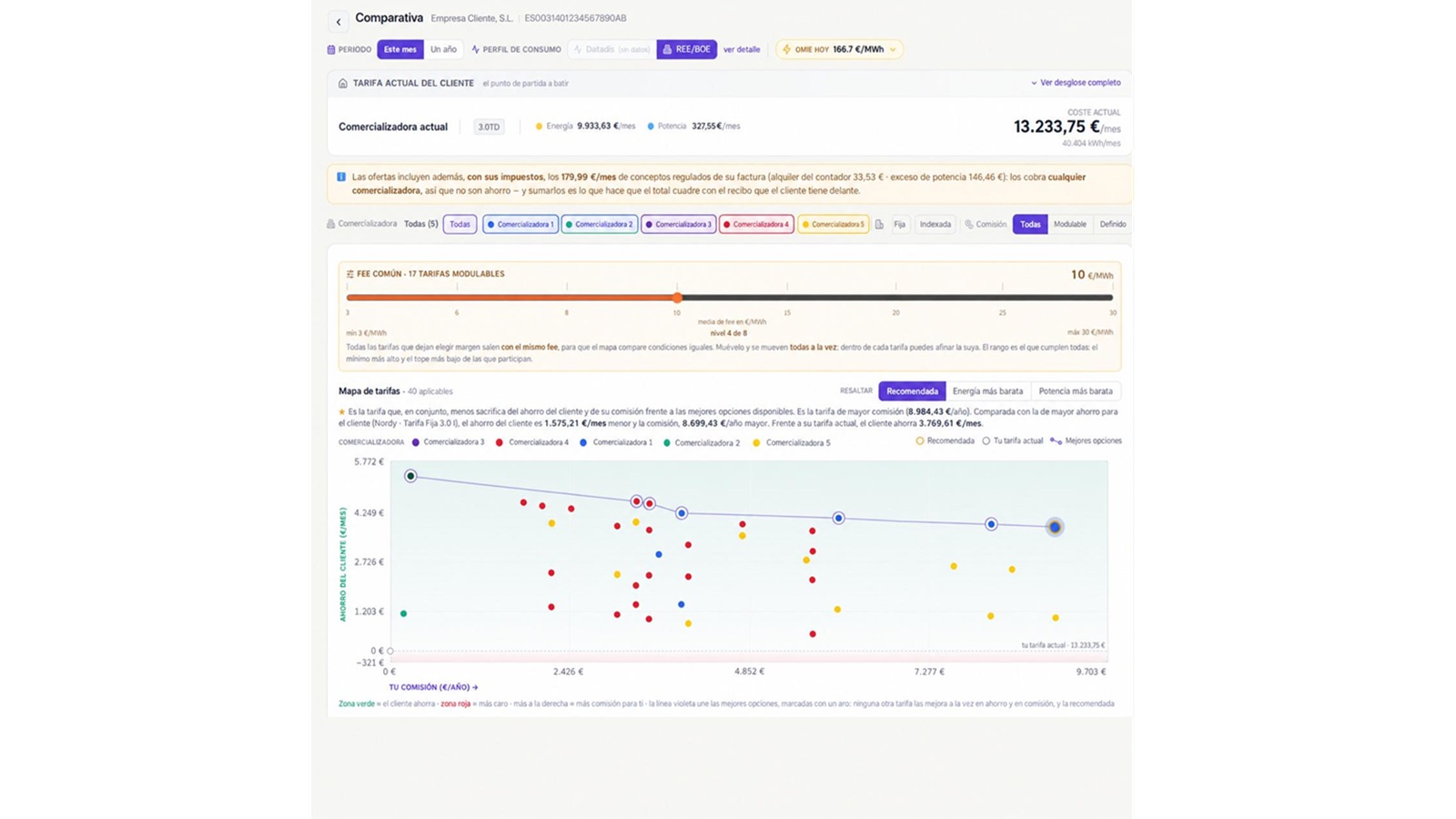
The sharp rebound in energy prices is once again putting electricity bills on the radar for Spanish companies. In this context, Moarys launches its activity, a new independent technology platform created so energy consultants can compare options, contract, and manage their clients’ operations from a single environment.
During September, the average price of electricity in the Spanish wholesale market surpassed €143.25/MWh, compared with less than €60/MWh in the same period last year. European gas is also experiencing high volatility driven by international geopolitical uncertainty.
For a small or medium-sized business, these movements can turn the review of its energy terms into a meaningful economic decision. And for the advisor representing them, the speed to detect an opportunity, compare options and execute a contract takes on special prominence.
From analysis to contracting without waiting for a back office
Moarys enables the advisor to manage from the platform the process that begins with the supply analysis and can continue with the comparison of offers, selection of a supplier, documentation, signature, monitoring, and after-sales service.
The difference lies in how that process is executed. In the traditional model, the advisor can prepare a deal and then send it to an intermediary energy consulting firm so that a back-office team rechecks the documentation, enters information, and processes the contract with the supplier.
Moarys aims to reduce that chain through automation and direct connections with the companies available on the platform.
“When the market moves quickly, reducing days, hours and intermediate steps can be as important as finding a good offer. An advisor who spots today an opportunity for their client shouldn’t have to wait for someone else to reprocess tomorrow what they have already prepared correctly. We want them to be able to analyze, decide and execute from the same place in real time,” says Víctor Sánchez, cofounder of Moarys.
Five suppliers linked and an open platform
Moarys begins its activity with five linked suppliers, though the forecast is that the available portfolio will steadily increase. The advisor can compare and contract among the companies available at any moment.
The company also announces an open-market policy: any energy supplier interested in offering its products to the advisors who work with Moarys can propose its incorporation, subject to the corresponding agreements and technical and operational requirements.
This openness is part of another differentiating element of the project. Moarys is not part of an intermediary energy consultancy nor does it aim to steer advisors’ portfolios toward a specific supplier. “We don’t want to decide where a advisor should take a client. We want to include more alternatives and give them the technology so they can decide themselves,” adds Víctor.
The independence of the platform is designed to prevent its business model from conditioning the professional’s commercial recommendation.
Greater agility in a volatile market
The current energy situation underscoring the value of this philosophy. The volatility of international markets is once again spilling over into European gas and electricity. Spanish industry has already warned about the economic impact that today’s energy costs could have in the coming months.
Moarys does not control energy prices nor can it prevent market swings. What it aims to do is provide the advisor with tools to react earlier when conditions change, so they can detect, compare, decide, and contract as quickly as possible without any single step depending on different people, schedules, or systems.
For the SMB clients being advised, this can facilitate a faster review of their contracts and access to available alternatives when market conditions change.
The advisor as the first line of defense
Moarys believes that, in a complex energy backdrop, the professional advisor can become even more relevant for small and medium-sized businesses. Their role isn’t limited to securing a price. They must understand consumption, contracts, expirations, and market conditions, identify when it makes sense to act, and guide the client through the decision.
Technology, in Moarys’ view, should allow them to devote more time to that function and less to chasing documentation, contract statuses, or administrative tasks. That is why the platform was built specifically around the energy advisor’s activity and not as a repurposing of a general CRM.
Clients, supplies, comparisons, offers, contracting, signing, monitoring, incidents, renewals, and commissions are all part of one unified environment.