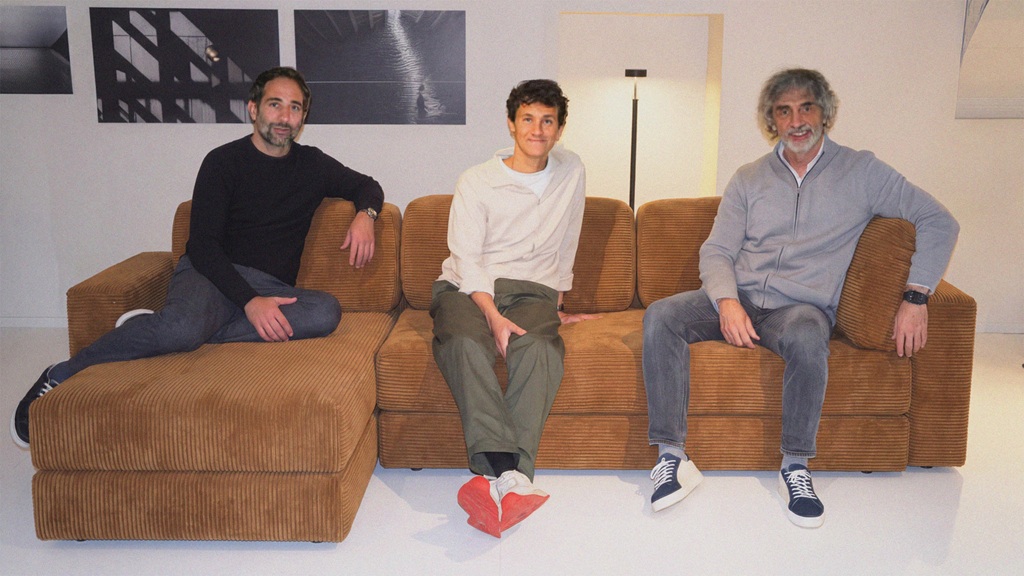
Bumbba is forecast to reach nearly €6 million in revenue this year. Specifically, between January and August, the company has already posted sales of almost €3 million. This puts it over €3.6 million in cumulative revenue since its launch in April 2025, with positive EBITDA from the outset of its activity.
The Spanish modular furniture brand also continues to show a blistering growth pace, up 594% compared with 2025, the year of its founding. In July alone, revenue exceeded €650,000, versus roughly €50,000 in the same month in 2025, multiplying its monthly sales by 13 in just one year. In its first 17 months of activity, Bumbba is approaching 5,000 customers across more than 15 European countries where it operates.
Thus, between January and August 2026, Spain accounts for 32% of revenue, while the remaining 68% is spread across European markets, with France (16%), Italy (11%), United Kingdom (7%), and Switzerland (7%) among the leading markets. The company is also present in countries such as Germany, Portugal, Belgium, Denmark, and Ireland, among others. It is now looking outward, with the United States as its next strategic market.
“Growing quickly is important, but doing so in a profitable way changes the nature of the project. In these first 17 months we have proven that there is real demand for a new way of thinking about the sofa and that we can turn it into a solid and scalable business,” says Josep Sánchez, co-CEO of Bumbba.
Digital model applied to a traditional category
Bumbba has built its proposition on its own product, direct-to-consumer sales, and digital distribution, applied to a traditional category like furniture. Its main product is a modular sofa system that can adopt different configurations and uses, in contrast to the traditional bulky furniture designed to stay in one fixed position. The company aims to bring to the furniture sector some of the changes that ecommerce has already triggered in other consumer categories.
Behind the project is a team with experience in creating and growing digital brands. Its principal shareholder and cofounder, Toni Estellé, was also founder of Marmota, one of the first Spanish brands to introduce the bed-in-a-box model and transform mattress shopping through the online channel.
Marmota grew to become a reference in ecommerce in its category and was acquired in full by Grupo Flex in 2021, in a move aimed at reinforcing the digital strategy and the direct relationship with the consumer for the Spanish manufacturer.
“With Marmota we proved that a category as traditional as the mattress could change when the buying experience is rethought. With Bumbba we are applying that learning to furniture,” explains Toni Estellé, cofounder of Bumbba. The prior experience of its founding team has been one of the pillars on which Bumbba has built its growth strategy and international expansion.
United States, the next strategic market
After consolidating its presence in Europe, Bumbba is preparing its entry into the United States, with commercial activity expected to begin by the end of 2026. It will be the company’s first market outside Europe, where it currently operates in more than 15 countries and concentrates 68% of its revenue outside Spain.
The U.S. market represents an opportunity for Bumbba to bring its direct-to-consumer model and modular furniture proposition to a larger market. The expansion will rely on the experience accumulated during its first 17 months of activity and on a structure that, according to the company, enables growth while keeping a focus on profitability.
“The United States allows us to make a decisive step in building Bumbba as an international brand. Our goal is to take there a proposition that has already proven its ability to connect with European consumers and to see how far it can grow in a market of this scale,” notes Josep Sánchez.
New categories to keep growing
Bumbba’s strategy does not stop at the living room. The company has recently launched Sunbba, a new modular outdoor furniture concept for gardens and terraces that applies the same philosophy of flexibility and adaptability to exterior spaces. The launch is part of the company’s strategy to progressively extend its model into new categories and spaces, while maintaining a consistent brand proposition.
The company thus begins a new phase with the aim of establishing itself as one of the European references in modular and flexible furniture within a global market that still offers substantial room for innovation, digitalization, and the creation of new brands.