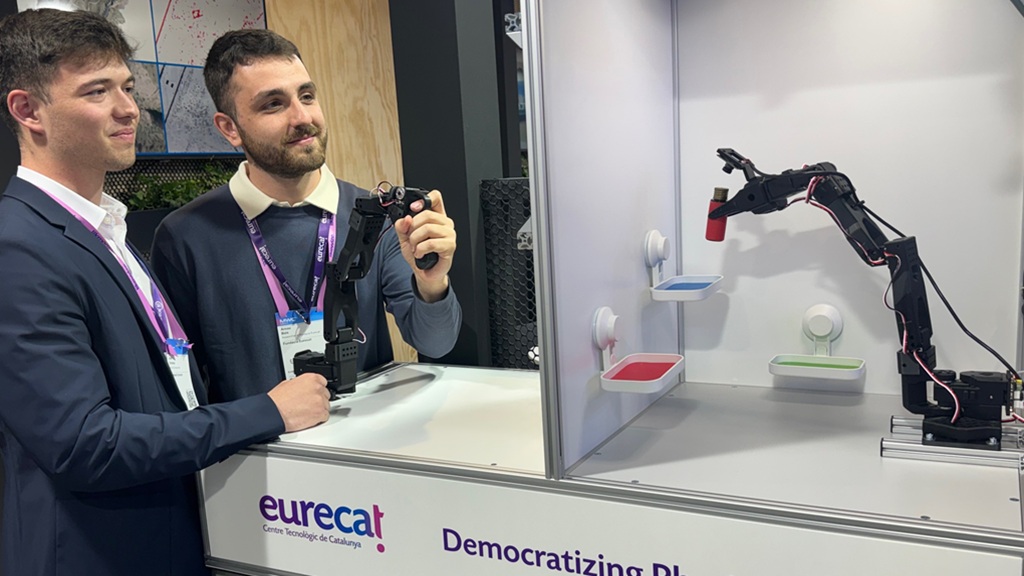
The Eurecat technology center has developed a new robotic system powered by generative artificial intelligence applied to the physical world, capable of learning new tasks by watching how people perform them and executing them autonomously. The center leveraged the recent Mobile World Congress to show the public how it trains for restocking welcome amenities in a hotel room.
The technology is based on a new vision-language-action AI model that, unlike traditional rule-based systems, can understand natural language instructions, interpret the visual scene, and directly generate the actions the robot must take. This evolution marks the move from digital AI to physical AI, where models interact directly with the real world.
The robot demonstrated this capability at the event, restocking welcome amenities in a hotel room. Specifically, based on task instructions given in simple terms, the system analyzes the environment, plans the movements, and executes the action autonomously.
Bringing AI into the physical world
“We are bringing artificial intelligence into the physical world with technology applicable to several sectors such as healthcare, manufacturing, or agriculture. So far, large language models have revolutionized text generation, but the big challenge is turning this into real-world actions—and doing so safely. This is what we call physical AI,” explains Eurecat’s Robotic Manipulation lead, Néstor García.
“Robots need real-world data to learn, and these data are much scarcer than those in the digital world. At Eurecat, we are working to close this gap and enable robots to learn with fewer data and more efficiently,” he adds.
Eurecat is pushing for “democratizing robotic learning so that any small or medium-sized business or professional can teach a robot new tasks with few demonstrations, in an intuitive and, above all, safe way,” explains Eurecat’s Cognitive Robotics lead, Magí Dalmau, who notes that “this helps reduce reconfiguration time and accelerate the introduction of automation across multiple sectors to boost company competitiveness and productivity,”
The system integrates a range of technologies developed by Eurecat to address the challenges of robotics based on generative AI, such as more data-efficient learning methods that require less data, techniques to leverage human videos as training sources, or hybrid strategies to ensure safe and reliable behavior in real-world environments. We attach the press release with all the details, two images, and the audio of the statements