The marine environmental consultancy Versemar has implemented the Environmental Monitoring Plan (PVA) for the project to regenerate more than 11 kilometers of the Valencian coast. It is driven by the Directorate-General for the Coast and the Sea through the Valencia Coastal Demarcation and is currently being carried out by the joint venture Dredging International Spain and Rover Maritime.
With an investment of nearly €43 million, the project stands as the largest coastal regeneration investment in Spain’s history. The intervention, which began only a few weeks ago, is expected to run for about five months—a bold timeline given that beach restoration typically spans around a year—while three beaches will be restored simultaneously.
The project includes regeneration works through a substantial sediment input and environmental improvement measures on the beaches of Canet d’en Berenguer, Almardà, Corinto, Malvarrosa (Sagunto and Canet d’en Berenguer), El Perelló, Pouet, Les Palmeres (Sueca), Marenyet, and l’Estany (Cullera), aiming to restore coastal profiles and strengthen the stability of the intervened areas.
The regeneration is based on the extraction of sand from an offshore deposit off the coasts of Sueca and Cullera using the Bonny River suction dredger, one of the most advanced in the world, capable of operating at depths beyond 80 meters, and the dredged material will be transported to the beaches through a combined system of floating, submerged, and land pipelines.
According to the technical studies approved for the project, the total volume of sand to be dredged is estimated at more than 3.24 million cubic meters, a figure that meets the calculated needs to restore the different coastal stretches affected by sediment retreat.
Launch of the Environmental Monitoring Plan
For its part, Versemar has designed an Environmental Monitoring Plan (PVA) that will ensure compliance with current environmental regulations and the conditions set forth in the Environmental Impact Statement (EIS). Its purpose is to monitor and minimize the environmental impacts arising from the project, particularly those related to physical alteration of the environment, sediment mobilization, turbidity and water quality, as well as to protect habitats, communities and sensitive and species of interest present in the project zones.
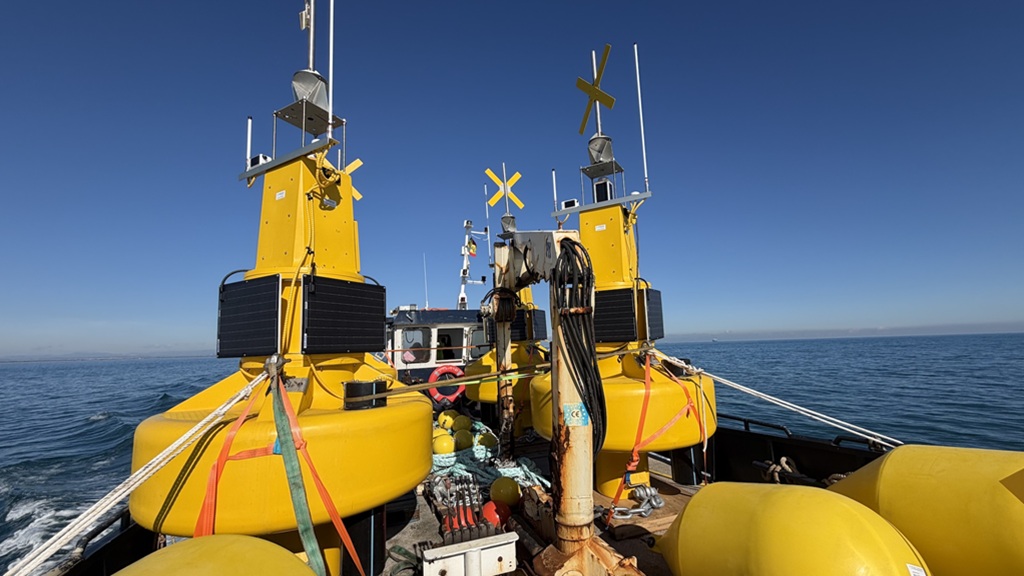
To guarantee exhaustive environmental monitoring, Versemar has implemented a continuous monitoring system using oceanographic buoys equipped with multiparameter sensors capable of measuring all parameters related to the water’s physicochemical quality, currents, and other data.
This system will enable the continuous acquisition of environmental data with real-time remote transmission through early warning systems that automatically trigger protocols and corrective measures.
Buoy-based monitoring is a differentiating tool, providing ongoing and precise control of environmental conditions and positioning this proposal as a benchmark in environmental surveillance.
In addition, the PVA includes other complementary actions, such as topobathymetric surveys, water and sediment sampling campaigns, biomonomic cartographies, monitoring the status of seagrass meadows, terrestrial communities, archaeological controls, among other tasks. After the works are completed, periodic controls and mid-term monitoring will be carried out to evaluate the recovery of coastal ecosystems and the effectiveness of the environmental measures applied.
“This project represents a first-rate technical and environmental challenge. Our role is to ensure that a project of this magnitude is carried out with the highest environmental guarantees, combining continuous monitoring, technical analysis, and the ability to respond immediately to any deviation,” says Versemar’s head, Alejo Muruaga.
This holistic approach positions the project not only as a major technical intervention but also as a benchmark in coastal environmental management, combining coastal engineering and marine protection with advanced monitoring systems.