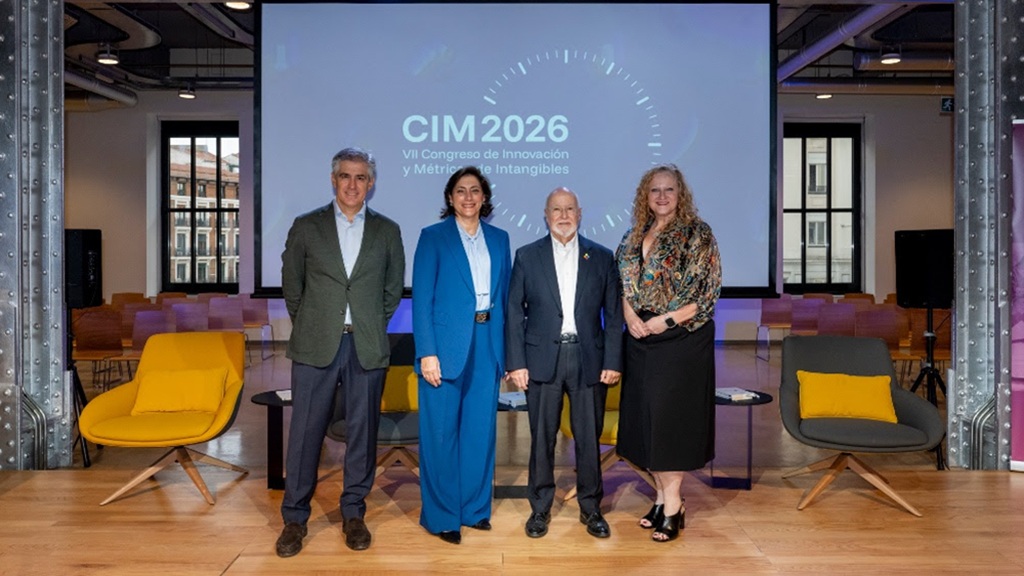
The measurement of intangibles is evolving from tracking indicators toward models capable of generating intelligence, demonstrating impact, and guiding business decisions. This has been one of the main takeaways from the VII edition of the Congress of Innovation and Intangible Metrics (CIM 2026), organized by Corporate Excellence – Centre for Reputation Leadership at Fundación Telefónica in Madrid, which brought together more than 30 national and international experts and 200 professionals.
During the day, new methodologies, models and business experiences were presented that show how measuring reputation, brand, communications, reputational risk, purpose, relational capital and social impact is advancing toward greater integration in management and decision-making processes.
Experts, companies, consultancies and academics have agreed that the challenge is no longer about having more indicators, but about identifying those capable of turning data into useful intelligence to understand what creates value, anticipate risks and opportunities, and demonstrate the contribution of the intangibles to the business.
“The challenge is no longer to prove that intangibles matter, but to be able to measure them with solid indicators that allow incorporating them into decision-making. In an economy where differentiation and social legitimacy are increasingly decisive, we need systems capable of measuring well issues such as reputation, corporate culture, the brand and stakeholder trust to evidence their contribution to the business.”
From Measurement to Decision-Making
One of the CIM 2026’s keys has been to show how the measurement of intangibles is already moving into business management. Through business cases, the Congress showcased concrete experiences of applying metrics to guide decisions, anticipate and quantify reputational risks, strategically manage the brand and assess impact and social value.
Among the companies sharing their experiences during the day were CaixaBank, COVAP, DKV, Globalcaja, Mercadona, Moeve, Redeia, Santander, Solunion, Telefónica and Ubesol, with different approaches to incorporating reputation, brand, risk and social impact into their management and decision-making processes.
New Models for Connecting Intangibles to the Business
The CIM 2026 also served to present new frameworks and methodologies that aim to advance one of the major challenges of intangible management: moving from measuring their evolution to demonstrating their contribution and using that evidence to take better decisions.
The international keynote of the Congress was delivered by Johna Burke, Global Managing Director & CEO of AMEC (International Association for Measurement and Evaluation of Communication), the international benchmark organization in measurement and evaluation of communication. Burke presented the latest international advances in this field, delving into the evolution toward models capable of connecting the performance of communication with the objectives and results of organizations. Her participation is framed within the strategic alliance between AMEC and Corporate Excellence for Spanish-speaking countries, through which both organizations promote best practices and contribute to advancing the professionalization of measurement and evaluation of communication.
Meanwhile, Macarena Estévez, founder of Cirentis, and Ángel Alloza, CEO of Corporate Excellence – Centre for Reputation Leadership, presented Corporate Mix Modelling, a new methodology aimed at measuring and demonstrating the contribution of the Corporate Affairs function to the business. The model seeks to provide new evidence on the contribution of Corporate Affairs to the business and strengthen the function’s ability to guide decision-making.
The economic quantification of reputational risk, the evolution of the value of intangible assets, advances in measuring reputation, social impact, relationship quality and the application of artificial intelligence to reputation completed a day marked by a search for metrics capable of turning data into useful intelligence for management.
“The CIM 2026 has shown that measuring well has become a strategic capability for organizations. It is not about turning qualitative data into numbers merely for the sake of having a metric, but about turning evidence into intelligence to understand what is generating value, what could put it at risk, and what decisions we should make,” said Ángel Alloza, CEO of Corporate Excellence – Centre for Reputation Leadership.