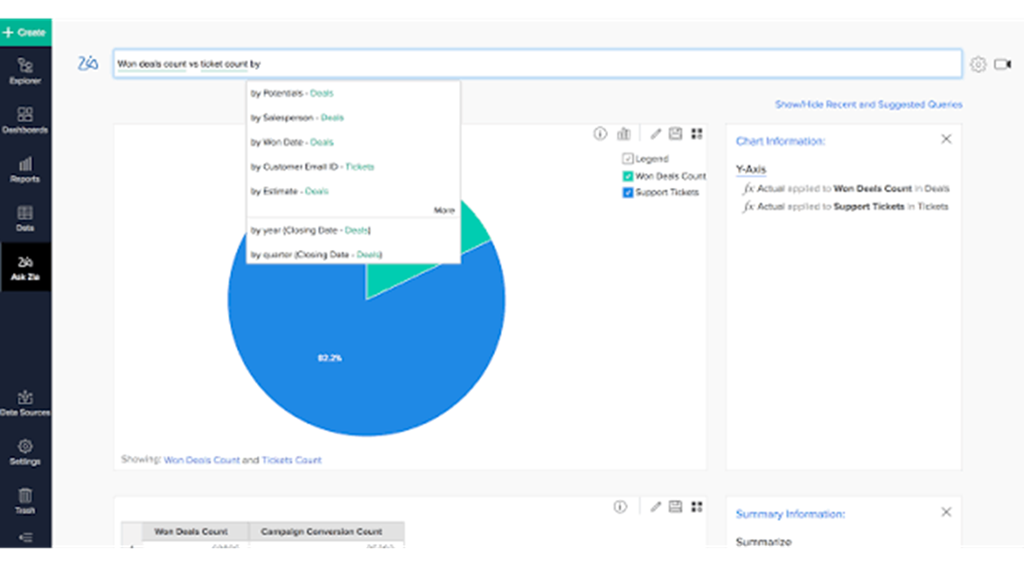
Zoho Analytics, the brand’s business intelligence (BI) solution, adds new AI capabilities to become an agentic analytics platform.
To this end, the company has introduced six AI agents specialized in tasks such as data preparation, model creation and analytics, result visualization, scheduling, and SQL generation. These agents are coordinated by Ask Zia, Zoho’s AI assistant for business intelligence. Users can give it natural-language instructions and Ask Zia selects the appropriate agents and combines their outputs.
«We are at the dawn of the next great leap in data analytics, where having a solid data foundation will be the starting point for any agentic activity within business operations. However, agents cannot operate solely on data; they need a robust layer of intelligence. The innovations we’re introducing in Zoho Analytics offer precisely that: a reliable, open, and extensible intelligence layer that provides a company’s AI tools with the context, metrics, and governance needed to generate responses users can trust,” says Sridhar Iyengar, Zoho’s CEO for Europe.
Among the key innovations are a semantic layer and an ontological model that allow companies to define, for example, what they consider revenue, how certain metrics are calculated, or what relationships exist between different data sets. These definitions form the basis for analyses performed by AI agents and are also available to external agents, applications, and workflows. In this way, the AI embedded in the application can interpret results in the specific context of each company and offer recommendations tailored to its operations.
Both the semantic layer and the ontological model are integrated directly into Zoho Analytics. Setting them up requires no programming knowledge nor a standalone data platform or a cloud data warehouse. Companies can create their own semantic models for different departments, and, thanks to the open standard Apache Ossie, use them outside Zoho Analytics as well.
More than 30 new connectors
Ask Zia preserves the conversation history, so users don’t have to start from scratch with each new query. Companies can choose to use Zoho’s own language model or an external one. In addition, they will now be able to create their own AI agents and determine which tasks they are empowered to perform autonomously.
Zoho Analytics adds more than 30 new connectors to its more than 500 existing integrations, including Zoho ERP, SAP, PayPal, Adobe Commerce, Twilio, Notion, and Intercom. The Model Context Protocol (MCP) enables external AI applications to access Zoho Analytics. Moreover, custom agents can be integrated into other apps and customer portals.
Cost control and data governance
A centralized data catalog helps you trace provenance and the analyses that rely on it. Security and governance controls regulate access to information and facilitate monitoring of AI agents. This way, administrators can verify who is using the agents, what data they access, what responses they provide, and the costs generated by different teams.
The new AI agents and analyses can be tested before they go into production and, if necessary, rolled back to previous versions. External AI agents, applications, and workflows can also leverage Zoho Analytics’ analytical capabilities and business context. Additionally, agents can be integrated directly into other applications, maintaining existing access permissions and security policies.
«With this launch, Zoho brings together several elements needed to develop scalable, governed agentic analytics, including native semantic and ontological layers, governance and monitoring capabilities, and the ability to deploy these features both embedded in applications and independently via MCP. Its stated commitment to openness and interoperability should help organizations leverage contextualized information for their decisions,” says Megha Kumar, IDC Vice President of Analytics and AI Research.