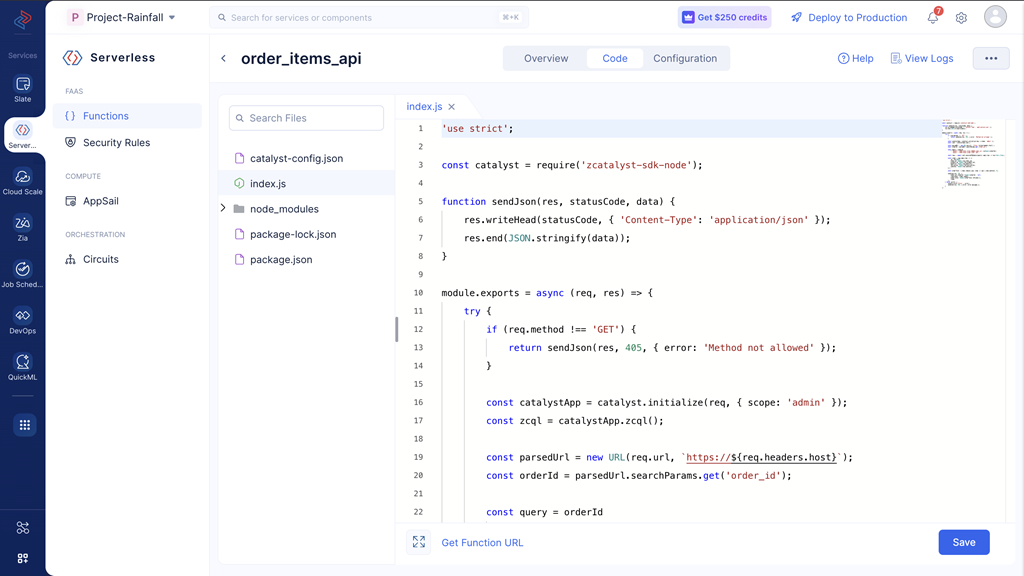
Zoho Corporation has refreshed Catalyst by Zoho, its platform as a service (PaaS), which incorporates new agent-enabled development capabilities directly into developers’ programming environments.
Among the novelties are Agent Skills, a non-interactive command-line interface (CLI) and compatibility with the Model Context Protocol (MCP), in addition to new integrations with agent-based AI programming assistants, such as Claude Code from Anthropic and Codex from OpenAI.
Designed for systems integrators and software companies building complex solutions, as well as independent developers who want to move from prototype to production without having to manage the infrastructure themselves, Catalyst by Zoho now also offers a free program for students that includes full-stack hosting, features, databases and AI tools, with the goal of making these technologies more accessible and supporting new talent.
«In a very short time, AI-powered coding assistants, like Claude Code, have transformed the speed at which applications are created, but getting that code into production and making it work reliably remains one of the biggest challenges. Developers still spend too much time wiring together disparate cloud services and managing infrastructure. Catalyst by Zoho eliminates that complexity. By offering a serverless full-stack platform engineered for agents, Catalyst enables developers and AI agents to create, deploy, and scale intelligent applications with cloud-provider independence and a substantially lower operational burden», says Sridhar Iyengar, CEO of Zoho in Europe.
From AI-generated code to production-ready applications
AI-powered coding assistants can generate code quickly, but taking it to production requires deep knowledge of the platform, cloud services, and deployment processes. Catalyst brings all these elements together in a single serverless full-stack platform and gives AI coding assistants the capabilities needed to build, test, and deploy applications into production.
Catalyst Agent Skills provides AI programming assistants with the context they need to understand Catalyst’s services, architecture, and recommended development patterns. Instead of letting the model decide on its own how to use Catalyst, the Skill guides the assistant toward the most appropriate tools and workflows. By showing only the functionalities relevant to each task, it helps assistants pick the best tools and services while enabling token usage optimization and achieving precise, verified results, even with smaller models.
The non-interactive CLI enables AI programming assistants to run multi-step workflows end-to-end in Catalyst without human intervention at every stage. This reduces manual tasks and speeds up the journey from development to production.
The Catalyst MCP server lets AI programming assistants access Catalyst’s capabilities directly from the developer’s usual workspace. Actions such as creating a table in a database or adding a column can be performed directly from VS Code, Claude Code, Cursor, or any AI-enabled IDE, without having to switch to the Catalyst console. This way, the entire development process stays within a single workflow, accelerating the production deployment of the application.
The orchestration, embedded in the Skill, connects these three capabilities. When an AI programming assistant needs to decide how to execute a request, the Skill directs it to the CLI or to MCP, rather than leaving that choice to the model. This approach simplifies the developer’s job, reduces the risk of choosing an inappropriate tool, and helps generate more complete applications ready for production.
A Zoho platform designed with human oversight
While each service can operate correctly on its own, managing a fragmented technology stack can increase operational complexity and complicate security, privacy, and governance. Applications built on Catalyst run in Zoho’s own data centers and are backed by the company’s security infrastructure, which includes DDoS protection, SOC compliance, periodic vulnerability assessments and penetration testing (VAPT), a web application firewall, and other measures.
- Human oversight is integrated into the deployment process itself, rather than added afterward, enabling organizations to maintain a higher level of control as AI becomes part of application development.
- The separation between development and production environments ensures that code only moves to production with manual approval. In this way, the AI agent does not directly access the production environment, reducing the risk of errors from autonomous intervention.
- Access controls and permissions determine who—or what—can participate in development and what actions they can perform.
- Complete activity traceability facilitates oversight through logs of applications, the platform, and tool calls via MCP. From these data, developers can precisely know what actions the AI agent took and when. All changes made after deployment are versioned, tied to their author, and can be rolled back.