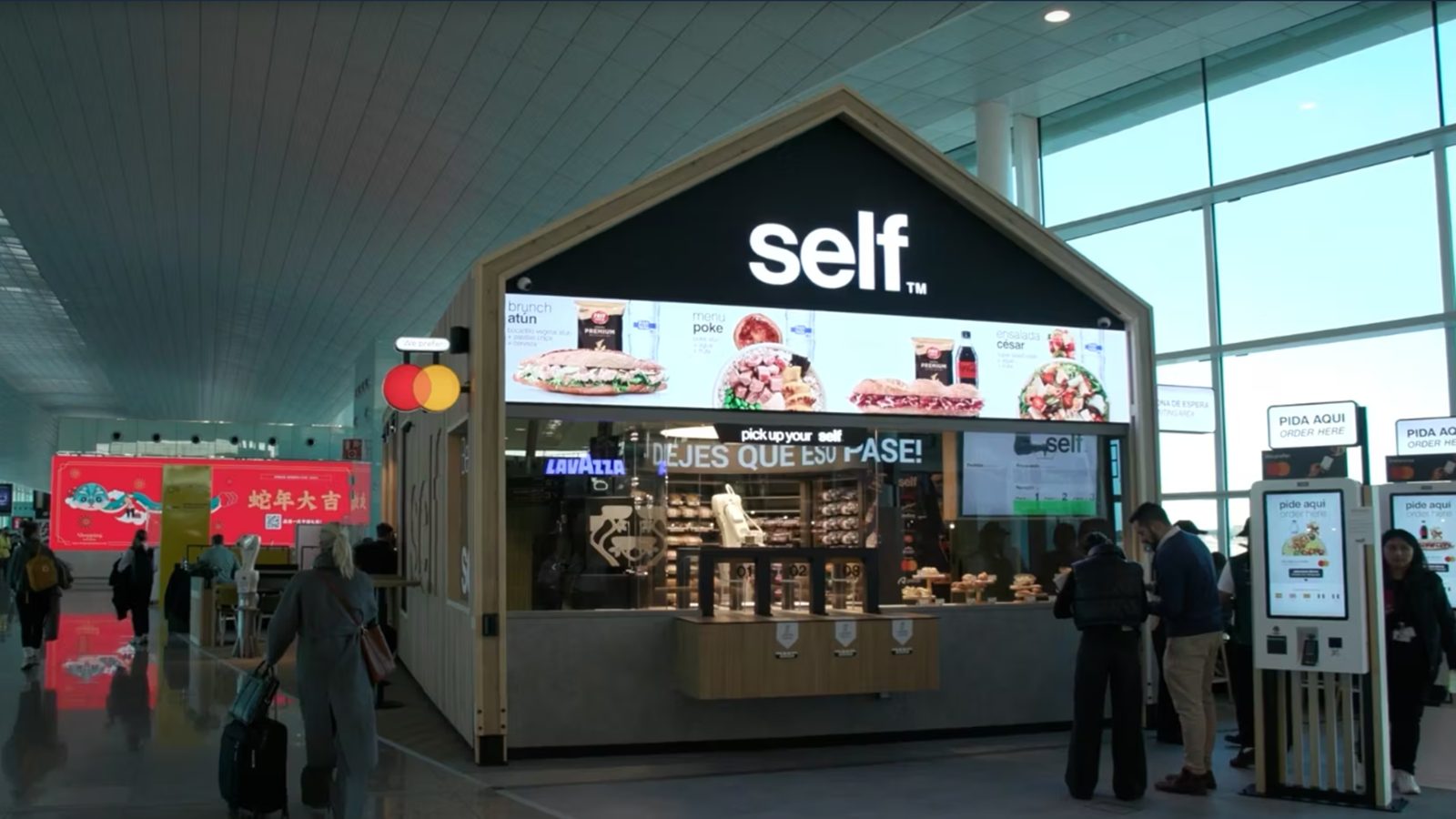
In an airport where time is a scarce resource and innovation becomes a strategic ally, the Barcelona–El Prat Airport has become the stage for a technological milestone in the dining industry. There stands Areas by SELF, considered the world’s first AI-powered robotized restaurant inside an airport. This pioneering concept not only redefines travelers’ dining experience but also charts a new path for automation and efficiency in the hospitality sector.
The establishment is the result of a collaboration between Areas, a Spanish multinational specializing in travel catering, and the tech company SELF, which has developed a robotic system capable of preparing and serving food in a fully automated way. The proposal responds to a growing trend: integrating artificial intelligence, robotics, and automation into dining services to offer speed, precision, and a novel consumer experience.
How it works
Located in one of the transit hubs of Barcelona–El Prat Airport, the restaurant grabs attention from the moment you see it. Through a transparent structure, customers can observe how robotic arms and automated systems coordinate to prepare different dishes. The process starts with the order, placed via digital screens. Once confirmed, the system’s artificial intelligence organizes the preparation, assigns tasks to the robots, and manages production times so the dish is ready in a matter of minutes.
The culinary offering includes hot dishes, quick options, and recipes designed for the contemporary traveler, who seeks quality but also speed. The robotic system helps maintain consistent preparation standards, reducing human error and guaranteeing the same quality with every order. Moreover, the technology used optimizes ingredient use and reduces food waste, an aspect increasingly relevant for sustainability in the industry.
According to Areas, the goal is not to completely replace human staff, but to transform their role within the restaurant. Workers focus on customer service, maintaining the system, and supervising the technological operation. In this way, automation becomes a tool that complements human labor rather than replaces it.
The artificial intelligence powering the restaurant also collects data about demand, preparation times, and customer preferences. This information enables optimizing the operation, adjusting the food offering, and improving the user experience. In an environment like the airport, where peak demand can vary significantly over the day, this adaptability is particularly valuable.
The impact of the project has transcended the airport itself. The initiative has generated interest among hospitality and tech-innovation professionals, who see in this model a possible evolution of traditional restaurants, especially in high-footfall settings such as airports, railway stations, or shopping centers.
That recognition was recently materialized with the awarding of one of the Horeca New Business Models Awards, prizes that highlight innovative projects capable of transforming the business model in hospitality and dining. The accolade acknowledges Areas’ commitment to integrating artificial intelligence and robotics in a real-world public service environment, as well as its potential to inspire new solutions in the industry.
The robotized restaurant also raises questions about the future of work in hospitality. While some experts warn about the impact automation could have on employment, others highlight that technology opens new professional opportunities related to the management of intelligent systems, tech maintenance, or data analysis.
In any case, Areas by SELF represents a concrete example of how artificial intelligence is beginning to transform sectors traditionally tied to manual labor and direct service. In a space where millions of travelers pass through each year, the restaurant has become a small window into the future of dining.
Between curiosity, innovation, and efficiency, travelers passing through Barcelona–El Prat Airport can watch robots prepare their meals while they wait for their flights. A scene that just a few years ago seemed straight out of science fiction and that today has become a daily reality.
With its recent recognition at the Horeca New Business Models Awards, the project reinforces its role as one of the most advanced experiments at the intersection of gastronomy and technology. And all signs point to what is today a novelty in one airport could become tomorrow a replicable model in many other dining spaces around the world.
The piece The world’s first AI-powered robot restaurant is revolutionizing Barcelona Airport is originally published by MuyPymes