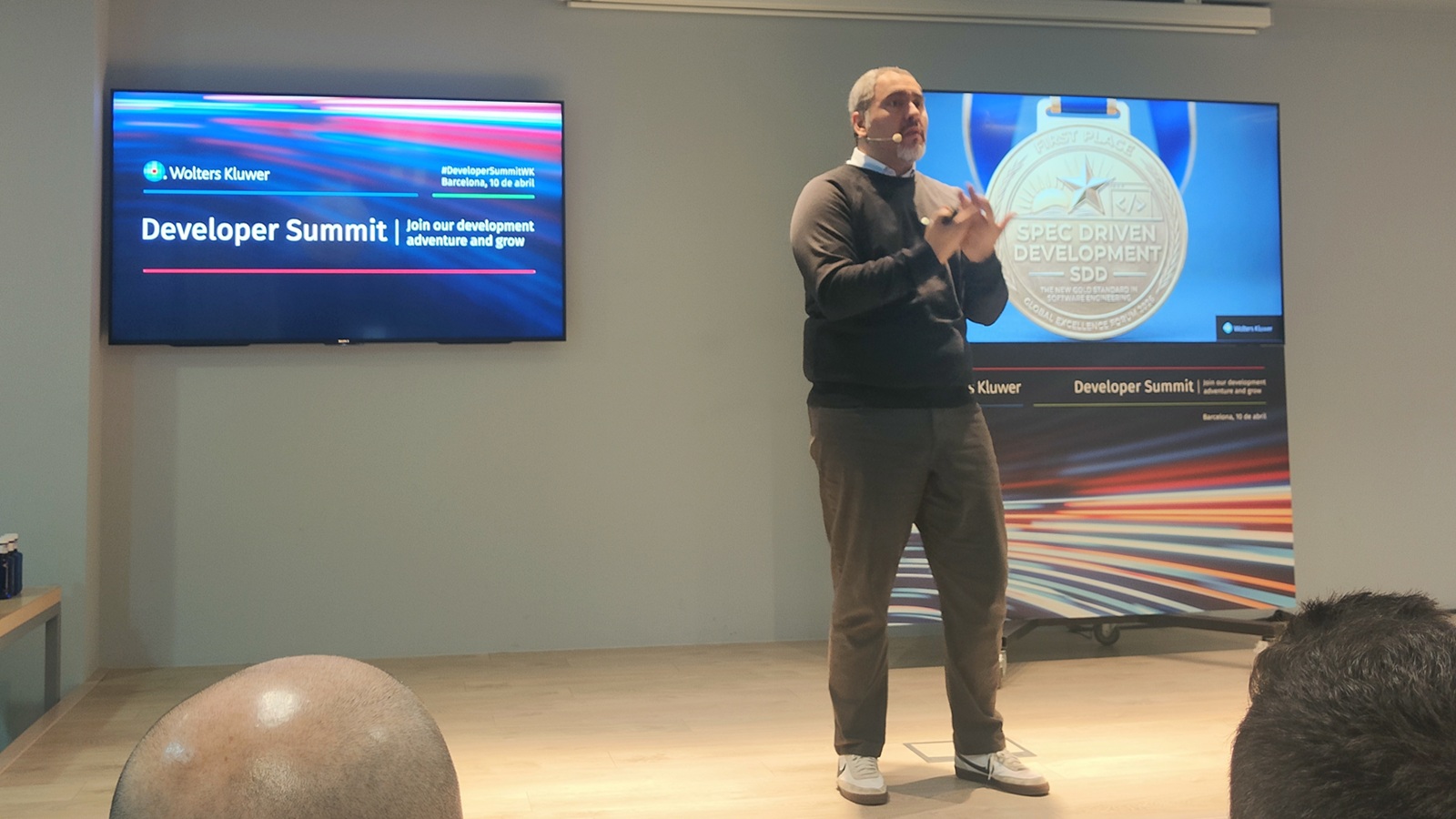
The Developer Summit 2026 of Wolters Kluwer, held last week in Barcelona, once again focused attention on one of the tech ecosystem’s biggest challenges: how to adapt software development to an environment that is increasingly regulated, automated, and shaped by artificial intelligence.
During the event, the company reinforced its commitment to turning its platform into an innovation hub for developers, where integration, efficiency, and regulatory compliance coexist as key pillars. In this sense, one of the main highlights was the progress of its API ecosystem, designed to facilitate connections between in-house solutions and third-party ones, especially in areas such as electronic invoicing, taxation, and business management.
The artificial intelligence played a central role, not only as a trend but as an element already integrated into development processes. Wolters Kluwer demonstrated how AI is being woven into its solutions to automate tasks, improve decision-making, and optimize the user experience, with particular attention to data reliability and regulatory compliance, two critical aspects in regulated sectors.
Another axis of the event was the impact of regulatory changes —such as those stemming from tax digitalization— on software development. The company underscored the importance of anticipating regulations like Verifactu, positioning developers as key actors to guarantee the technological adaptation of businesses and professional firms.
Additionally, the summit served to strengthen the relationship with the partner and developer community, highlighting the need to build a collaborative ecosystem capable of accelerating innovation and responding with agility to new market demands.
Overall, the Developer Summit 2026 made it clear that the future of development lies in blending automation, intelligence, and compliance, in a context where technology no longer just drives the business but also ensures its alignment with an increasingly demanding regulatory environment.
Alex González: “AI is going to completely change roles”
During the event, we had the opportunity to speak with Alex González, Wolters Kluwer’s Director of Product Software Engineering, who shared his views on various aspects of AI. He discussed the changes this technology could bring to professionals in the field, the updating of brand-management tools, and developers’ interest in embracing or avoiding these solutions.
“AI is going to completely change roles, but that does not mean it will eliminate them. It will completely change the roles. But that does not mean it will eliminate them. In the end, what will prevail is the concept of shift left.” In software development, this means integrating testing, security, and quality control from the early stages of the lifecycle (requirements and design) rather than at the end.
“Now, the developer has to be positioned in those phases, because the coding phase is the one that is going to be automated, thanks to the increasingly efficient technologies that are appearing. That does not mean the profession will disappear, far from it. In the end, the technical product has to remain technical, and for that, a technician must be behind it ensuring that it is correct. But that professional must take on a different role.”
Does that technical role need to know software?
“Undoubtedly. But it does have to be a more left-shifted role, more focused on design, on specification, on understanding software solutions in full. The human team will now ensure that execution is correct in everything they do. To designers I say: you shouldn’t worry, but you should focus on your transformation, on your evolution. Because if you don’t, the tsunami will sweep you away. Up to now, what has worked for decades was enough, but from now on it’s not enough to rely on that alone.”
Do you think most of those developers are aware of this evolution?
“Everything depends on two factors: your willingness to be an explorer and your personal curiosity. But you also have to consider the level of innovation and bravery in your organization. Not everyone is an explorer, not everyone works in a company with that level of responsibility and courage. For us, this is an absolute priority.”
“And I, personally, as CTO, feel responsible for the professional growth of my 225 engineers. That doesn’t happen everywhere. Not everyone has that explorer drive. Many people have lost their passion for technology along the way, especially since the 1990s.”
Where is AI currently making the biggest impact?
“The entire lifecycle is being transformed, but the main focus today in the market, not just among competitors but in the market itself, is coding. That’s the primary focus.” There are other tasks within the lifecycle that are also changing, from PR reviews, to reviewing contributions, to managing product integration, to observability, obviously the whole area of product discovery, use-case functionality, prototyping. In other words, all the actors operating in the software development lifecycle, in any phase, are innovating.
“From one day to the next you realize that, in all phases, your reference counterparts for functional prototypes and code management, for the infrastructure… they’re pulling innovations through AI.”
“If coding moves faster, the rest of product evolution, the accessories to development, and even the evolution of the AI itself, also move faster. So the main focus is there, but the rest of the lifecycle is evolving as well. One of the capabilities of generative AI is to generate ideas. You present a general idea and it can return a possible structure for what you want. Or you want it to do something, but you have to structure it in the design phase, and that’s where engineers have to think about how to do it, how to structure from the start.”
Are you working with startups or smaller companies that specialize in AI to become more agile in product development?
“To date there is still no consensus, meaning you can’t go to the market and hire the best consulting firm in the world to teach you how to do this. We’re all discovering it and building consensus among ourselves.”
“Our stance is very firm and we’re very advanced. We’ve engaged consultants to help us and they haven’t been able to assist us. We knew more than they did, or at least as much.” “Today we have Marsbase with us. They’re a small consultancy that works for large clients. When you’re working for yourself, a small company, the quality standards you have to enforce, the transferability of your product to the other timeline, is less relevant than if you bear the responsibility we do.”
“At Wolters Kluwer we have tens of thousands of clients, with millions of payrolls, millions of taxes in cities, and tens of millions of invoices per month. So, the quality standards and practices of a small company don’t serve us. In fact, there’s a market trend that I believe is the path for companies like ours.”
“Artifacts, specifications, versioning, governance, scalability, cost management… all of that has to be adapted to the realities of a corporation. So, the experience of a small company isn’t directly transferable, because they don’t face these challenges.”