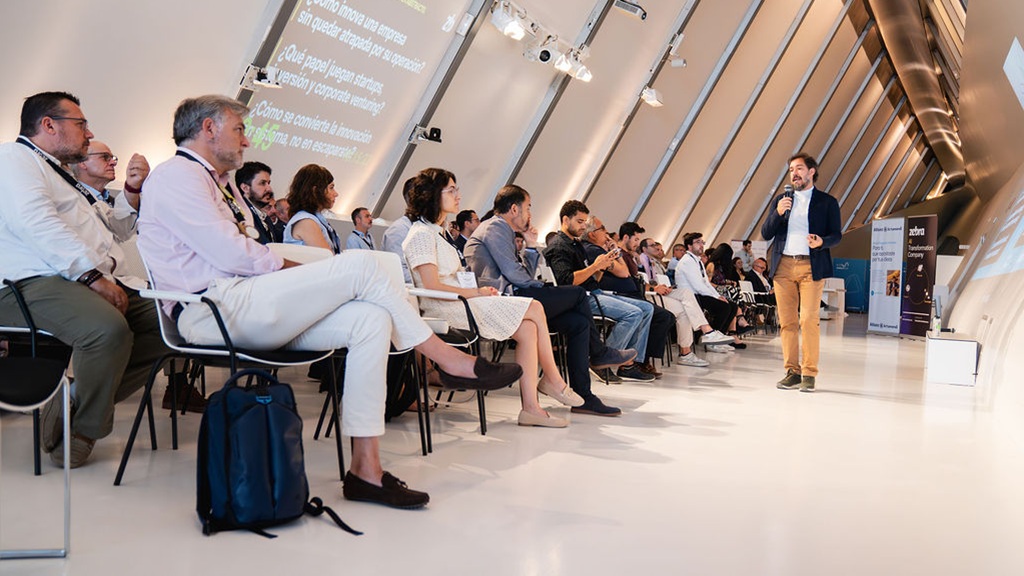
The Spain Innovation Summit 2026 wrapped up its fourth edition with more than 300 business leaders, and a takeaway that aptly sums up the moment many Spanish small and medium-sized businesses are navigating: artificial intelligence cannot be deployed successfully unless people, processes, and the way work is organized within the company are reviewed first.
The event, organized by Zebra Ventures, established itself as a meeting point to address AI applied to business from a practical perspective. During the day, the Real Digital Transformation and AI Deployment in Spanish SMEs study was also presented, based on a sample of 278 companies from various sectors and domains.
The first day, held at Mobility City, focused on open innovation, investment, and the startup ecosystem. The program included two roundtables with representatives from Deloitte, Premoney, Embou, GoGoTechy, Grupo Fersa, and Factorial. But the approach departed from the traditional pitch format: this time it was the companies presenting their real challenges and the startups listening and responding with potential solutions.
Addressing concrete problems in the business ecosystem
That shift in focus allowed the conversation to land on concrete problems. It wasn’t merely about talking about AI as a trend, but about understanding what barriers prevent companies from truly leveraging it. In this context, Ulises Gómez, cofounder and Chief Innovation Officer at Zebra Ventures, argued for the need to build “ambidextrous” companies capable of solving the current business while continuing to look toward the future.
The second day took on a more operational character. Through three practical workshops, attendees conducted their own diagnostic, identified internal frictions, and designed an initial executable step to advance their digital transformation. The workshops were led by the Zebra Ventures team, with Sergio Martínez, the company’s CEO, at the helm, joined by Ulises Gómez, along with Pablo Romeo, Mariano Taborda, José María Martínez, and Daniel Sanz.
One of the main messages of the gathering was that technology, by itself, doesn’t transform anything. For an AI project to work, the company needs prepared teams, documented processes, and a clear view of which problem it intends to solve. In other words, before deploying tools, it’s worth knowing where inefficiencies lie, which tasks repeat themselves, what information is lost, and which decisions could be made better with data.
From there, another major conclusion of the event: invisible processes are hidden costs. Many SMEs operate with undocumented dynamics, heavy dependencies on certain individuals, or workflows that run “because they’ve always been done that way.” When those processes are not measured or analyzed, any automation attempt risks digitizing the disorder.
The third pillar was the return. Zebra Ventures argued that there is no credible transformation without a measurable return and that AI projects should be able to justify their investment in less than twelve months. If they don’t, the issue may lie not in the technology but in the project design, the choice of use case, or the lack of a solid organizational base.
During the event Toolbox was also presented, an educational guide designed so that each company can address its digital transformation according to its technological level, as well as Sabana, a resource, training, and networking space for executives powered by Zebra Ventures.