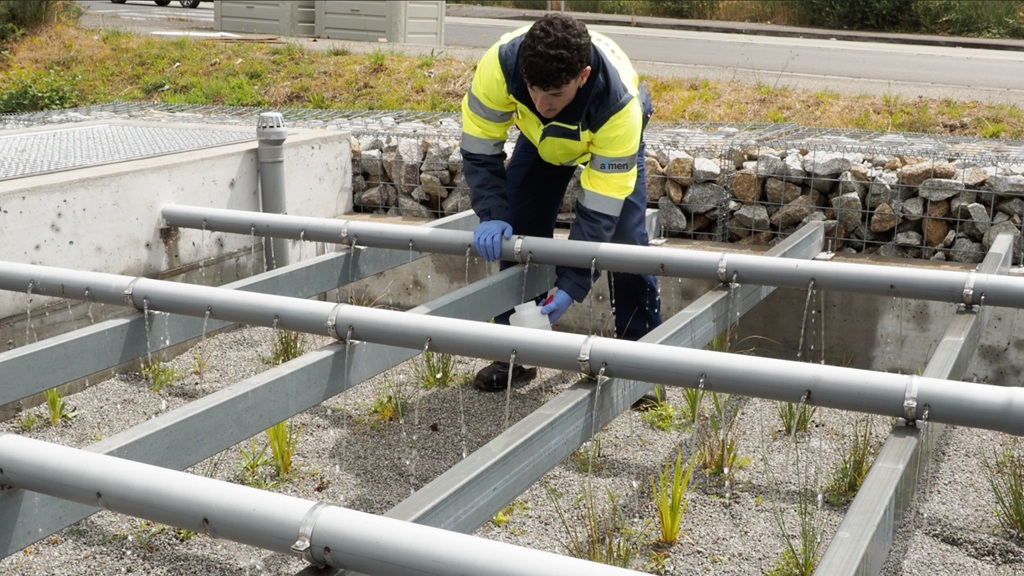
In the framework of the European WATERUN project, coordinated by the AIMEN Technology Center, innovative solutions have been developed to prevent and mitigate rainwater contamination in urban environments. Pilot actions implemented in Santiago de Compostela have achieved the removal of up to 90% of certain contaminants present in urban runoff, namely the rainwater that carries waste and pollutant particles along streets and through industrial areas.
These results have been possible thanks to the application of sustainable drainage systems and nature-based solutions, adapted to the urban environment in different locations within the A Sionlla and Tambre industrial estates. These measures also help prevent contaminants from reaching rivers and aquatic ecosystems.
Innovation to Improve Urban Water Management
Funded by Horizon Europe, WATERUN aimed to transform urban runoff management by developing tools for identification, planning, and risk control, as well as new working procedures and best practices tailored to today’s environmental challenges.
The project has also incorporated co-creation processes to adapt solutions to different territories. In these processes, in Galicia, public administrations such as Augas de Galicia, Environmental Health officials, and the City of Santiago, as well as water-management entities, the scientific community, urban planners, and citizen representatives, have participated.
In the words of Luz Herrero, the technical coordinator of WATERUN at AIMEN, “WATERUN represents an important step toward a new way of managing water in cities. The project has allowed validating innovative tools and methodologies in real urban settings and demonstrated that nature-based solutions can have a direct impact on improving water quality and urban resilience in Galicia.“
The measures carried out in Compostela are part of one of the three case studies selected within the WATERUN project, alongside Aarhus (Denmark) and Amman (Jordan). These scenarios have been chosen for their different climatic, urban characteristics, and levels of implementation of measures to improve water quality in urban areas, allowing the methodology to be validated in a range of international contexts.