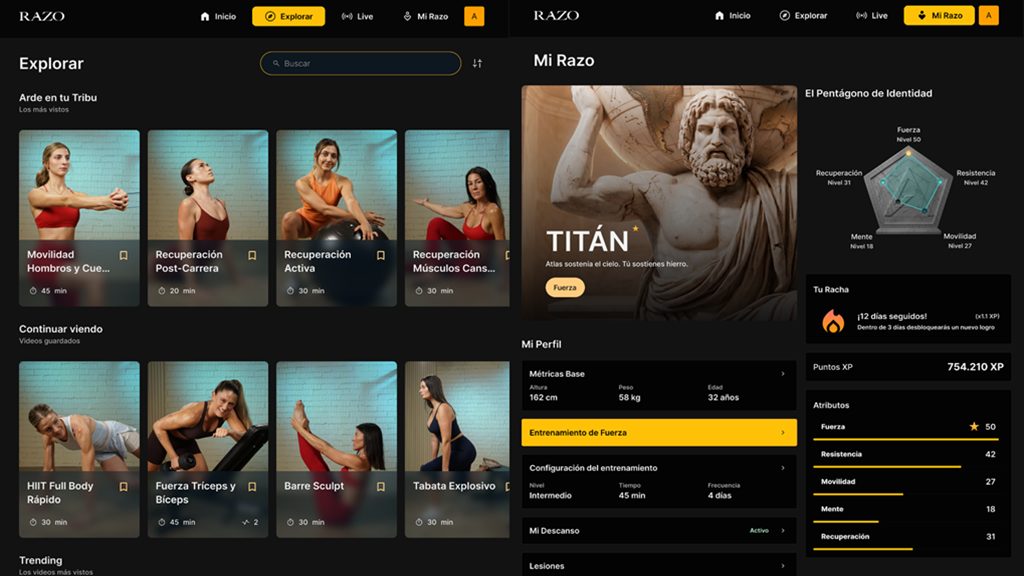
Crys Dyaz & CO. has launched RAZO, a mobile platform (iOS and Android) and web designed to tackle some of the biggest challenges in digital fitness: content selection, session personalization, and user consistency. Instead of relying on traditional video catalogs, RAZO features its own allocation engine that selects the most suitable session based on each user’s profile and circumstances. The app is now available with an introductory rate of about $32 per month.
In the words of Crys Dyaz, CEO of Crys Dyaz & CO. & Salud FEM by Crys Dyaz: “We want to accompany people as they reach their goal for the first time in life (without frustration) or perhaps shift the focus because you’re rediscovering yourself.”
Software architecture and gamification
The accumulated experience and learnings over the years have allowed that first proposal from Crys Dyaz & CO. to evolve into RAZO, conceived as a hybrid ecosystem that connects digital training with the in-person experience at the Crys Dyaz & CO centers. These centers maintain a meaningful role within the platform, integrating also into its gamification and rewards system, which will give users access to experiences and training sessions at the centers, among other benefits. Additionally, the platform will progressively incorporate new extras and experiences to broaden the user’s possibilities and enrich their experience within the ecosystem.
The app’s software architecture rests on a deterministic allocation algorithm that runs four filters before offering each class. The first layer, named Bodyguard, acts as an absolute safety filter discarding any content incompatible with injuries declared by the user, applying restrictive logic for pregnancy and postpartum profiles. Next, the Butler filter evaluates the user’s logistics by analyzing the available time, equipment, and identifying the concrete training environment—whether at home, in a fully equipped gym, or in a hotel room during travel. The final layers, Coach and Day Butler, order and adjust the session according to the objectives, the level, and the day-to-day context.
Example of the app ecosystem
In the gamification and user experience section, RAZO avoids generic medals by introducing a progression system tied to training physiology. Each completed session distributes points across five key attributes: strength, endurance, mobility, mind, and recovery. The development of these metrics gives the user a progression archetype inspired by Greco-Roman imagery, such as Titan, Spartan, Pegasus, or Oracle. To align with real life, the algorithm includes protective mechanisms with gentle degradation of level after several days of inactivity, tier floors that lock in achievements, and a “vacation mode” that protects the user’s status during planned breaks.
“RAZO relies on its own selection engine that scores the entire catalog on every request against the user’s profile: level, job type, available duration, session history, and sleep signals and heart-rate variability arriving via API from their wearable (starting in October). On top of that layer runs a streaming infrastructure with latency under a second that allows live sessions with Crys to be truly real-time,” notes Ander Tellería, creator of RAZO.
The visual and playback experience has been designed to eliminate any interference during training. The player will include, by the end of the year, a dynamic anatomical muscle map that lights up on screen at the exact moment the class changes, indicating which muscle groups should activate. Furthermore, when casting the app to a television, the player will integrate voice commands to pause or resume the video without needing to touch any device with occupied or wet hands.