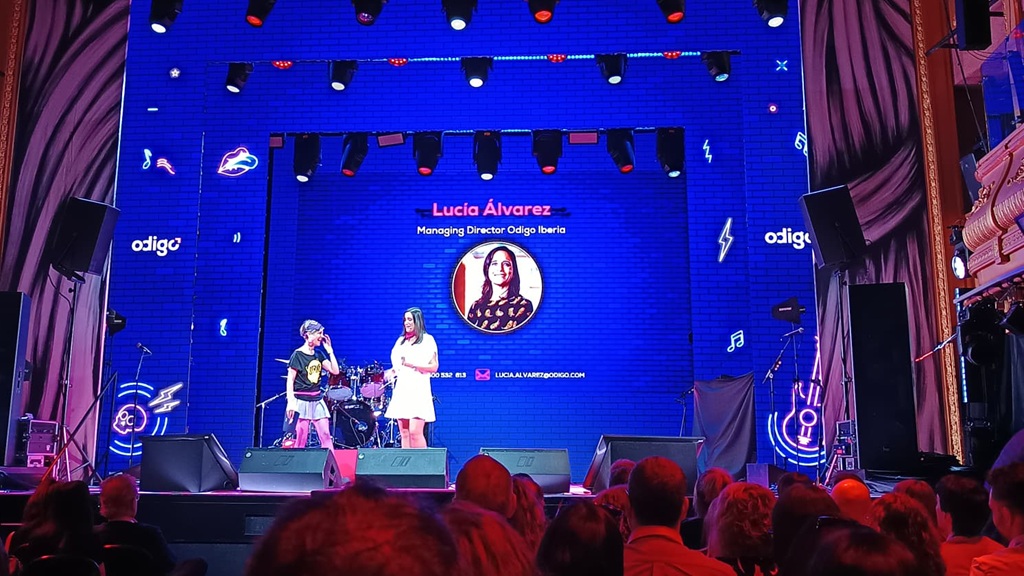
Odigo recently celebrated, in Madrid, a new edition of Odigo CX Day, the annual gathering that brings together clients, partners, and experts to share trends, use cases, and strategies that are redefining the relationship between brands and consumers.
The edition of this year has a particularly symbolic character as it marks the company’s 40th anniversary, four decades marked by technological innovation and constant evolution to meet the new needs of customer service.
During the day, inspired by this edition of one of the most influential cultural movements in our country, the Movida Madrileña, those responsible for customer experience, operations, technology, and innovation addressed some of the sector’s main challenges, such as integrating artificial intelligence into support services, hyper-personalization, operational efficiency, and the need to deliver seamless and consistent experiences across all channels.
A gathering to share innovation and real-world cases
The Odigo CX Day 2026 program combined market vision, technology demonstrations, and real transformation experiences developed alongside reference clients.
At the opening of the event, Javier Llosá, a Member of Odigo’s Board of Directors, addressed the impact of artificial intelligence on the fabric of business and advocated for a pragmatic approach to this technology, focused on the real value it can bring to organizations and users. “As with other major technological revolutions, there is a lot of hype around artificial intelligence today. At Odigo we maintain a clear focus: helping organizations translate that innovation into more efficient, personalized, and sustainable experiences,” he said.
For her part, Lucía Álvarez, Managing Director of Odigo Iberia, shared the company’s vision for the future of customer experience, marked by the convergence between customer service, marketing, employee experience, and brand, as well as the growing importance of regulation and technological sovereignty in Europe. “Celebrating our 40th anniversary alongside customers and partners at such a special edition of Odigo CX Day has been an excellent opportunity to recognize the journey so far and share our future vision. Today customer experience is no longer understood in isolation: service, employees, brand, and technology form part of the same conversation, and the companies that know how to integrate it all will be the ones to make a difference in the coming years,” she stated.
Among participating clients, RACC explained its approach to building a differentiated customer experience in the field of roadside assistance and 24/7 support. The Getxo City Council, together with Teknei, presented a project aimed at improving the relationship between administration and citizens through technology. Likewise, Deutsche Bank shared its experience in innovation and operational excellence in contact center environments.
The event, hosted by Sara Escudero and closed with a performance by Loquillo, also showcased new capabilities of the Odigo platform and highlighted, through concrete use cases, how artificial intelligence and automation are transforming customer experience across multiple sectors.
40 years of technological evolution in service of the customer
Founded in 1986, Odigo began its journey by responding to the growing demand for advanced communication solutions. Since then, the company has evolved at the pace of each technological revolution: from early telephone services, through digital and internet expansion, to becoming a pioneer of the cloud model applied to contact centers.
But that’s not all. In the last decade, it has strengthened its international positioning as a leading player in Europe, with recognition from analysts such as Gartner and ISG. It has also driven a sustained growth strategy based on innovation and expansion. In this line, corporate operations such as the acquisition of Akio in 2025 have helped strengthen its value proposition and consolidate a solid European technology alternative in the CCaaS and CX markets.
Spain, a strategic market for Odigo
Spain plays a significant role in the company’s European trajectory. Odigo has offices in Valencia, where one of its main headquarters is located, and Madrid, from which it maintains close relationships with clients, partners, and institutions. Between the two, they employ more than 200 people and run its two main lines of business: Odigo Enterprise and Odigo Essential.
In the Spanish market, Odigo has been helping leading organizations modernize their customer service operations for years, driving projects based on cloud solutions, automation, and artificial intelligence.