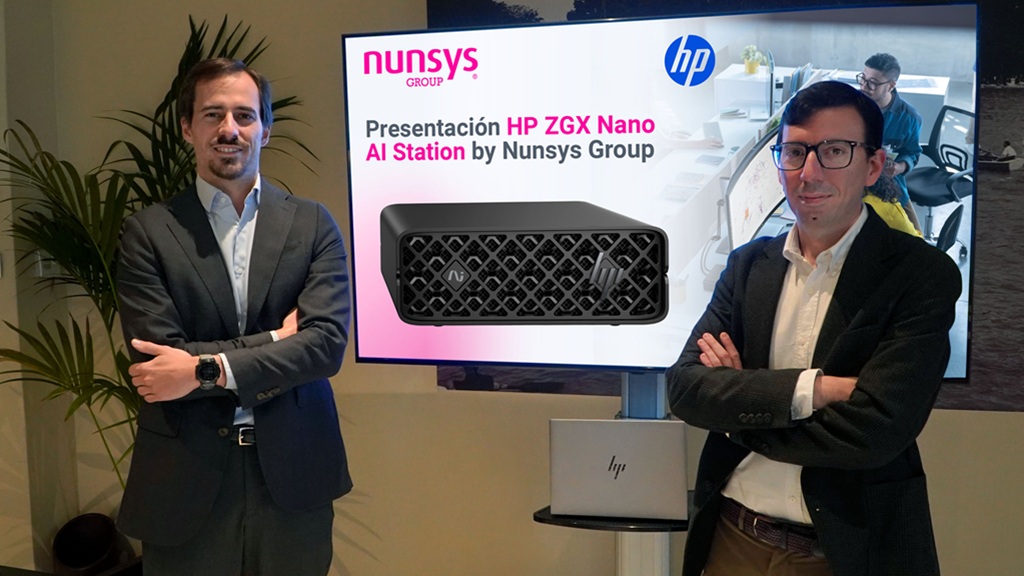
HP and Nunsys Group have unveiled in Spain the new HP ZGX Nano AI Station, an ultra-compact workstation geared toward advanced artificial intelligence (AI) workloads with unprecedented performance in a compact footprint.
In the session, with participation from Fernando Alcázar, HP’s Business Developer Manager for Advanced Computer Solutions, and Jorge Reverte, Nunsys Group’s Digital Strategy Manager, attendees had the opportunity to learn firsthand about the main capabilities of the new system and watched a live demo of its potential in professional environments.
During the event, Alcázar explained that the HP ZGX Nano AI Station sits within HP’s Advanced Compute Solutions ecosystem, designed to enable hybrid AI strategies that combine local computing and cloud computing. “This solution addresses the need to reduce cloud dependency by offering secure, scalable, high-performance local computing. In this way, companies can develop, test, and deploy AI models directly on their premises, optimizing costs and ensuring data control.”
Redefining Performance in Advanced AI
As the event hosts explained, the HP ZGX Nano AI Station represents a qualitative leap in high-performance computing by integrating supercomputing capabilities into a desktop form factor measuring just 15 cm, enabling locally running AI models of up to 200 billion parameters with performance up to 1,000 TOPS thanks to the NVIDIA Grace Blackwell superchip and its 128 GB of unified memory, which allows handling large data volumes and complex models directly from the desk. The unit also enables expanding its capabilities through interconnecting multiple devices to work on even more complex models.
Specifically designed for prototyping, fine-tuning and model inference, this solution addresses the growing demand for highly specialized roles such as engineers, AI developers, architects and professional creators, who require greater computing power without sacrificing efficiency and security. Moreover, the station incorporates the HP ZGX Toolkit, an open-source toolset that optimizes the entire lifecycle of AI projects.
For the Nunsys Group Digital Strategy Manager, this new generation of HP stations “marks a turning point in how organizations develop their AI projects: it enables prototyping, iterating, and tuning models at a speed that was previously viable only in cloud environments, but with the cost control and predictability of on-site infrastructure.” That foundation also opens the door to “bringing inference to the edge, right where the data is generated,” Reverte explained. The live demo conducted during the event showcased its ability to run compute-intensive workloads in real time, reinforcing its position as a key solution for sectors such as engineering, architecture, automotive, and manufacturing.
The launch of the HP ZGX Nano AI Station aligns with HP’s global strategy to drive an advanced computing ecosystem that enables IT departments to efficiently manage the growing complexity of workflows, combining performance, security, and sustainability. In this regard, the solution also uses recycled materials and sustainable packaging, aligning with the company’s environmental goals.