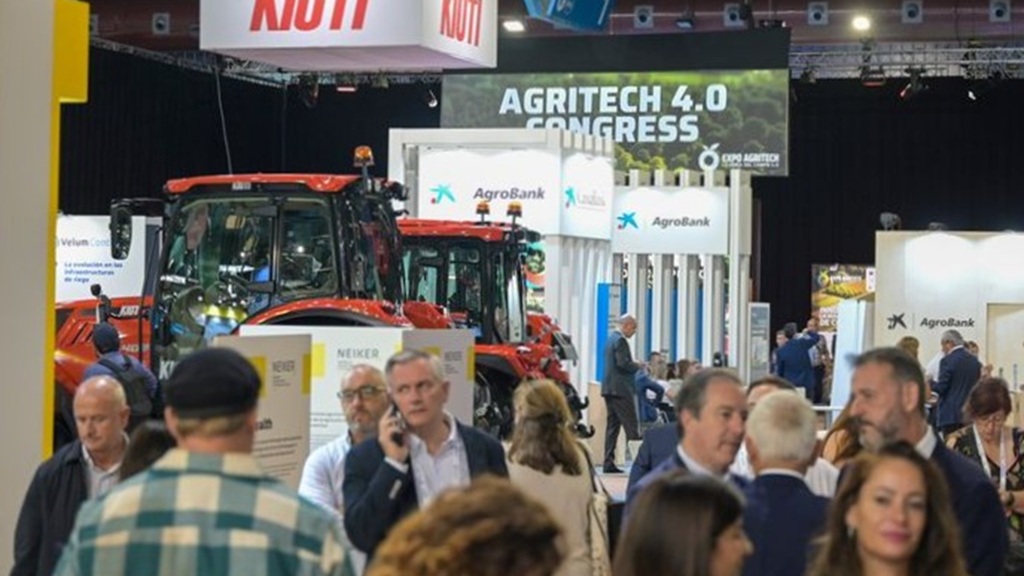
Soaring production costs, uncertainty in international markets, evolving consumer demands, and a lack of generational succession are pushing farmers to rethink how they run their operations. Against this backdrop, increasing profitability, diversifying income streams, professionalizing management, and strengthening competitiveness have become major priorities for the sector. Today in Málaga, Expo AgriTech 2026—the largest agricultural technology fair—is wrapping up, where strategies and new business models are being unveiled to tackle the challenges facing the industry.
To address these challenges, the AgriTech 4.0 Congress hosted two specialized forums aimed at farm owners and cooperatives, where strategies to improve profitability, diversify income, professionalize governance, and boost the sector’s competitiveness were analyzed. Through experiences and practical case studies, experts examined new business opportunities and the role of digitalization and the evolution of the cooperative model, sharing tools to facilitate decision-making and move toward more efficient and profitable farms.
New Business Opportunities and Entrepreneurial Farmers
The Farm Owners Forum examined the sector’s main economic and commercial challenges, in a context shaped by geopolitical shifts, rising costs, and the transformation of international markets. To analyze how these factors are conditioning production, distribution, and farm competitiveness, Thomas Fellman, Head of Sector Agriculture and Team Leader of the European Commission; Pedro Mauricio Barato, president of ASAJA; Juan Carlos Rodríguez, director of the cereal division of Dcoop; and Ignacio Atance, director of the Studies Service of the Cajamar Foundation, shared their strategic views to understand the future competitiveness of the industry and the Common Agricultural Policy (CAP).
Against this backdrop, farms are exploring new ways to boost income and reduce dependence on the marketing of harvests. Energy generation, by-product valorization, environmental services, and new sales channels are opening opportunities to diversify agricultural businesses. Juan Castilla, professor at the University of Almería; Francisco Vañó, general director of Castillo de Canena; Francisco Guerrero, manager of Cucarrete; and Miguel Tejerina, manager of Viñedos del Río Tajo, explored various alternatives to expand income sources, including experiences linked to agrivoltaics, which combine agricultural production with solar energy generation.
Another aspect the congress delved into was the evolution of the farmer toward an increasingly entrepreneurial profile. On this, José Luis Escobar, CEO of Berdea; and Antonio Domene, CEO of Moyca, outlined how to professionalize decision-making and move toward more profitable, scalable management models prepared to face the sector’s challenges.
In parallel, changes in consumer habits and the demands of distribution are transforming commercial relationships. In this arena, Rafael Piñero, Director of External Relations for the National Food Chain of Mercadona, and Beatriz Molina, manager of Grupo La Caña Nature, examined what the distribution sector expects from farmers by 2030 and how innovation, combined with greater collaboration among the various players in the chain, can help meet evolving consumer demands and improve competitiveness.
Cooperatives 4.0: Digitalization, Governance, and Generational Succession
Alongside farm owners, the AgriTech 4.0 Congress also dedicated a specific space to cooperatives, which are advancing to adapt their governance models to an increasingly competitive agricultural environment. Thus, the forum delved into digitalization, professionalization, and the evolution of governance as factors that can help improve the services they provide to their members and strengthen their market position. In particular, the digital transformation of cooperativism was examined, where data analytics or management platforms are enabling the optimization of production planning, technical advisory, traceability, and logistics optimization. To illustrate practical application, Juan Carlos Vega, head of the Technical Department at DCOOP; and Nicolás Juste, project coordinator at Anecoop, explained how these solutions are contributing to improving the efficiency of cooperatives and generating greater value for their farmers.
Another key aspect driving the modernization of the cooperative model is the need to professionalize governing bodies, strengthen member relations, and adapt to new generations. In this regard, Juan Sagarna, Director of Sustainability and Innovation Projects at Cooperativas Agroalimentarias, will analyze the sector’s structural challenges and how to move toward more efficient, market-oriented models. Alfredo Arbeloa, managing director of Grupo AN; Enrique de los Ríos, general manager of UNICA; and Víctor Luque, CEO of Trops, discussed the keys to evolving cooperative governance, driving generational succession, and leveraging data spaces to improve decision-making, among other production and commercial challenges.
Finally, the meeting also focused on the role of cooperatives in connecting farmers with consumers, strengthening product proximity, and contributing to food sovereignty. María Reyes López, manager of Guadalhorce Ecológico, shared how the cooperative model can help build trust in the food supply chain.