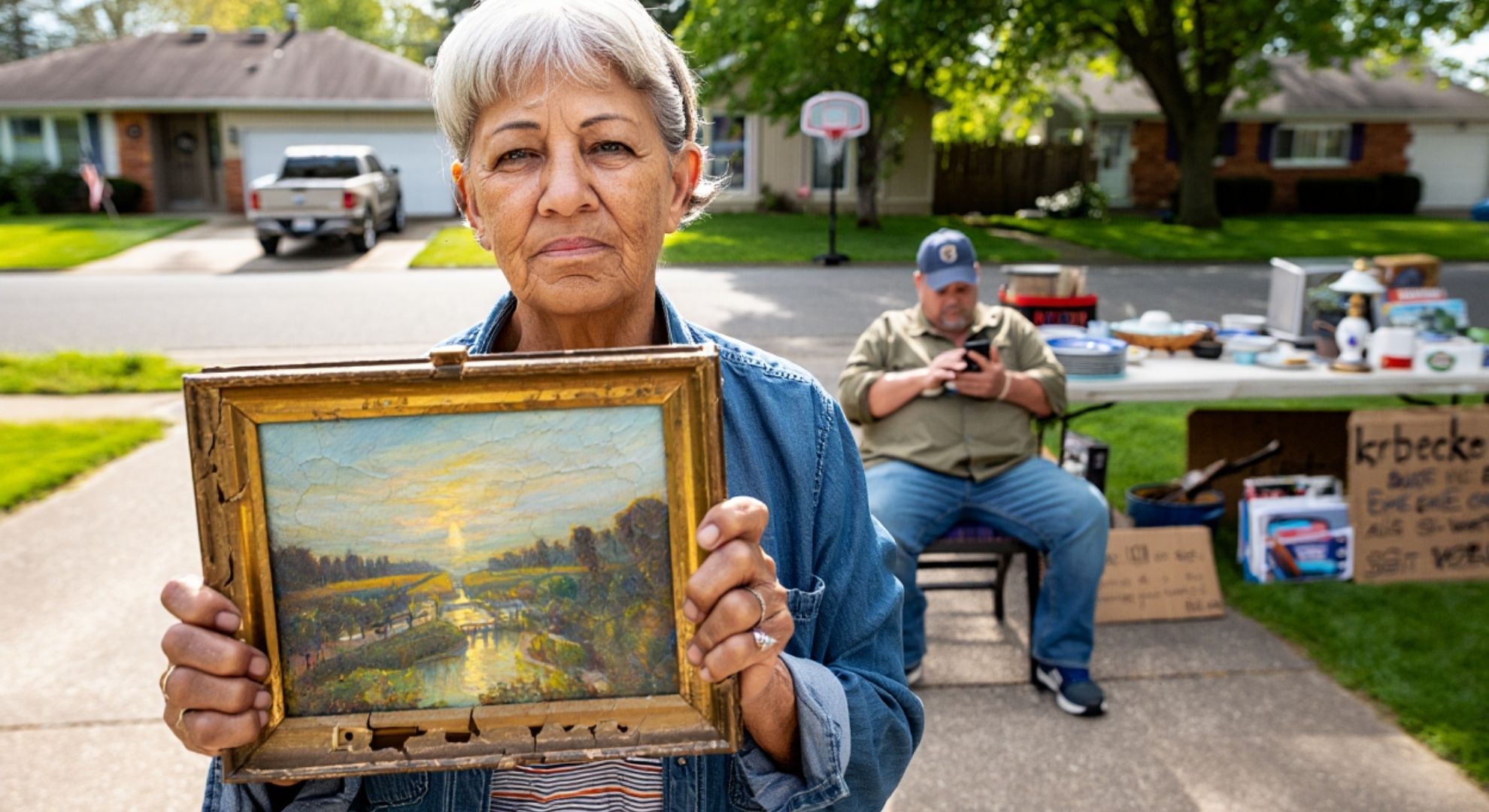
It was supposed to be an ordinary Saturday morning. Walking through a quiet neighborhood in Ohio, a retired teacher stopped at a modest garage sale, browsing through everyday objects: books, kitchenware, and a few framed pictures leaning against a wall. Among them, one painting stood out—not for its obvious value, but for something harder to define. For just $8, the buyer decided to take it home, unaware that the decision would soon attract the attention of experts and collectors alike.
At first glance, the painting did not appear extraordinary. The frame was worn, the canvas slightly aged, and there was no visible signature that could immediately link it to a known artist. Yet something about the composition—the brushwork, the depth of color, the subtle details—suggested that it might not be a simple decorative piece.
Back home, curiosity took over. The new owner began researching similar works, comparing styles and techniques. After initial online searches yielded inconclusive results, the painting was brought to a local appraiser. What followed was a process that would take several weeks, involving consultations with specialists and eventually the involvement of a major auction house.
A discovery that surprised even experts
Once examined by professionals, the painting quickly raised interest. Art historians identified stylistic elements consistent with a 19th-century American school, prompting further investigation. Advanced analysis of the materials, including pigments and canvas composition, confirmed that the work dated back to a period associated with several renowned American artists.
The turning point came when a specialist noticed similarities with a series of works believed to be partially lost. Archival research and comparative analysis eventually led to a striking conclusion: the painting was likely an authentic, previously unrecorded piece by a recognized American master.
“It’s extremely rare to encounter a work of this caliber outside of established collections. The fact that it surfaced in such an ordinary setting makes it even more remarkable,” noted one expert involved in the authentication process.
From garage sale to auction house
Following authentication, the painting was transferred to a well-known auction house for valuation. After a detailed assessment, its estimated worth was set at over $1.2 million, placing it among significant rediscoveries in recent years.
Such findings are uncommon but not unheard of. Works of art can sometimes disappear from records due to private sales, inheritance transfers, or simple misidentification over time. In this case, the painting had likely remained unnoticed for decades before resurfacing in a completely unexpected context.
Why discoveries like this still happen
While the art market is highly structured, gaps in documentation and provenance can occasionally lead to overlooked pieces. Several factors can contribute to such situations:
- Lack of visible signature or identifying marks
- Changes in ownership without proper documentation
- Misattribution or classification as decorative art
- Storage in private homes without expert evaluation
- Limited access to historical archives at the time of previous sales
These conditions create rare opportunities for rediscovery, often dependent on a combination of chance and informed curiosity.
A reminder of hidden value
The story highlights how objects of significant cultural and financial value can exist outside traditional channels. While most garage sale finds remain ordinary, this case illustrates that exceptions, though rare, are still possible.
For the retired teacher, what began as a minor purchase has become a case study in unexpected discovery—one that underscores the unpredictable nature of the art world and the enduring possibility that overlooked pieces may still be waiting to be found.