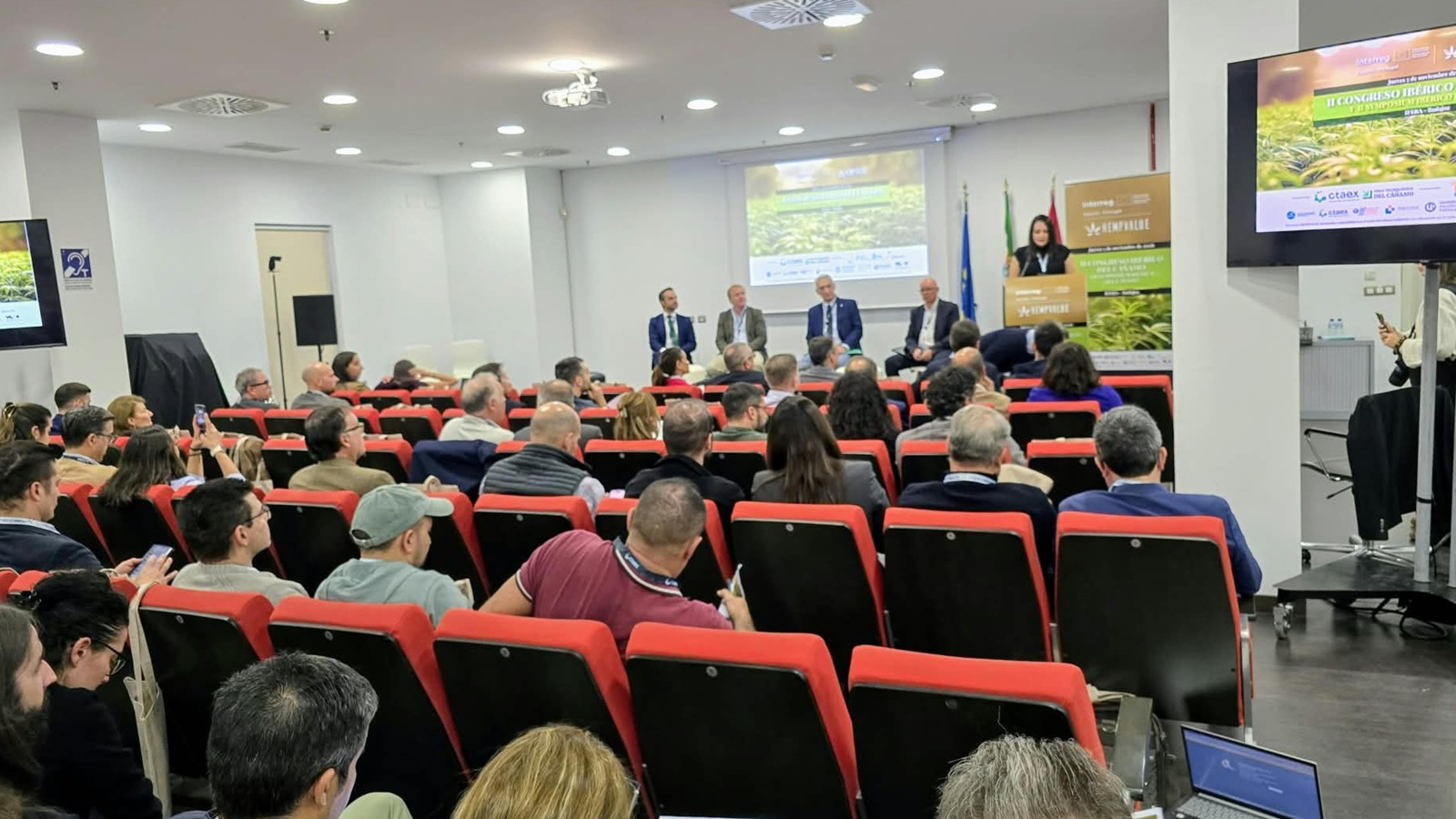
Badajoz brought together researchers, companies, technology centers, universities, and institutional representatives linked to medicinal cannabis and industrial hemp. The I Iberian Symposium on Medicinal Hemp and the II Iberian Congress on Hemp and II Iberian Hemp Symposium stood out for the strong turnout of professionals, the high scientific and technical quality of the presentations, and the interest in the economic development opportunities offered by both sectors.
The gatherings were promoted by the National Agro-Food Technological Center (CTAEX) and the Hemp Technology Hub, with the aim of fostering cooperation between Spain and Portugal, boosting knowledge transfer, and connecting research with the needs of the business community.
Medicinal cannabis brings together researchers and companies to analyze development prospects
The first meeting was the I Iberian Symposium on Medicinal Hemp, funded by the General Secretariat of Economy, Business and Trade of the Junta de Extremadura as part of its business dynamization initiatives.
The event provided a platform to analyze opportunities for positioning Extremadura in an emerging sector, as well as scientific advances, quality requirements, therapeutic applications, and the possibilities for investment and business development.
José Luis Llerena Ruiz, CEO of CTAEX, opened the sessions by outlining the Center’s trajectory in the hemp field, the role of the Hemp Technology Hub, and Extremadura’s scientific and technological capacities to drive this activity.
Subsequently, Montserrat Gómez Cardoso Bernet, head of the Physical-Chemical Analysis and Laboratory Quality Unit at CTAEX, emphasized the importance of characterization, cannabinoid analysis, contaminant control, and traceability as essential elements to ensure the quality and safety of products.
Business perspectives were represented by Eliecer López Jiménez, Director of Business Development at GreenBe Pharma; Concha Tiana Ferrer, Director of Cannatek; and Iker Val Valverde, CEO of Sovereign Fields, who shared experiences and opportunities related to the development of medicinal cannabis.
For her part, Guillermo Moreno Sanz, Scientific Director of Khiron Europe, addressed the current state of therapeutic cannabis, the available scientific knowledge, its applications, and the sector’s evolution outlook.
The meeting also featured Celina Pérez Casado, Secretary General of Economy, Business and Trade of the Junta de Extremadura, who discussed investment opportunities, business implementation, and the region’s development potential for this activity, in addition to delivering the institutional closing remarks.
The II Iberian Congress on Hemp highlights the potential of an industrial value chain
On the other hand, IFEBA hosted the II Iberian Congress on Hemp and II Iberian Hemp Symposium, held within the HEMPVALUE project, co-financed by the European Union through the Interreg VI-A Spain-Portugal (POCTEP) 2021-2027 program.
The institutional opening ceremony featured participants such as Juan José Manzanero Iniesto, President of CTAEX; Francisco Espinosa Borreguero, President of the Scientific Committee; José Manuel Benítez Medina, Secretary General for Science, Technology and Innovation of the Junta de Extremadura; and Ignacio Gragera Barrera, mayor of Badajoz.
The conference brought together national and international specialists who addressed the main challenges of industrial hemp, from seed availability and certification to fiber transformation and the development of new products.
The program’s thematic blocks offered insights into experiences related to varietal improvement, agronomic management, crop rotation, soil fertility, industrial processing, and the use of plant-derived materials.
Among the issues highlighted were the need to guarantee seed supply adapted to growing conditions, improve the competitiveness of processing methods, and develop local value chains that make it possible to valorize the different fractions of the plant.
The congress also dedicated attention to the European regulatory framework, with special emphasis on hemp uses in animal feed, human nutrition, and cosmetics, as well as the opportunities and limitations posed by current regulations.
Additionally, results from research projects such as MARGIN-UP and POCTEP BGREENER were presented, relating to the sustainability of cultivation, biodiversity, crop rotation, and the valorization of fibers and hemp shives for new industrial applications.
One of the standout aspects of the event was the II Iberian Symposium on Hemp, where studies were presented across four knowledge areas: plant physiology and biotechnology, biodiversity and climate change, agronomic management techniques, and the valorization of fibers and seeds.
The diversity of research underscored the multidisciplinary nature of hemp and the potential it offers for both farming and the development of new products and materials.
Among the lines of investigation were genetic improvement and varietal selection, the crop’s physiological responses under different stress conditions, the application of digital technologies and remote sensing to optimize management, and the assessment of its contribution to biodiversity and the sustainability of agricultural systems.
Special relevance was given to work on the industrial use of fibers and hemp shives, with applications in low-carbon construction materials, polymer composites, 3D printing, thermal insulation, and sustainable packaging.
Investigations into new food applications for the seeds, the use of byproducts in animal feed and aquaculture, and the economic opportunities that hemp could offer as an alternative to traditional crops were also presented.