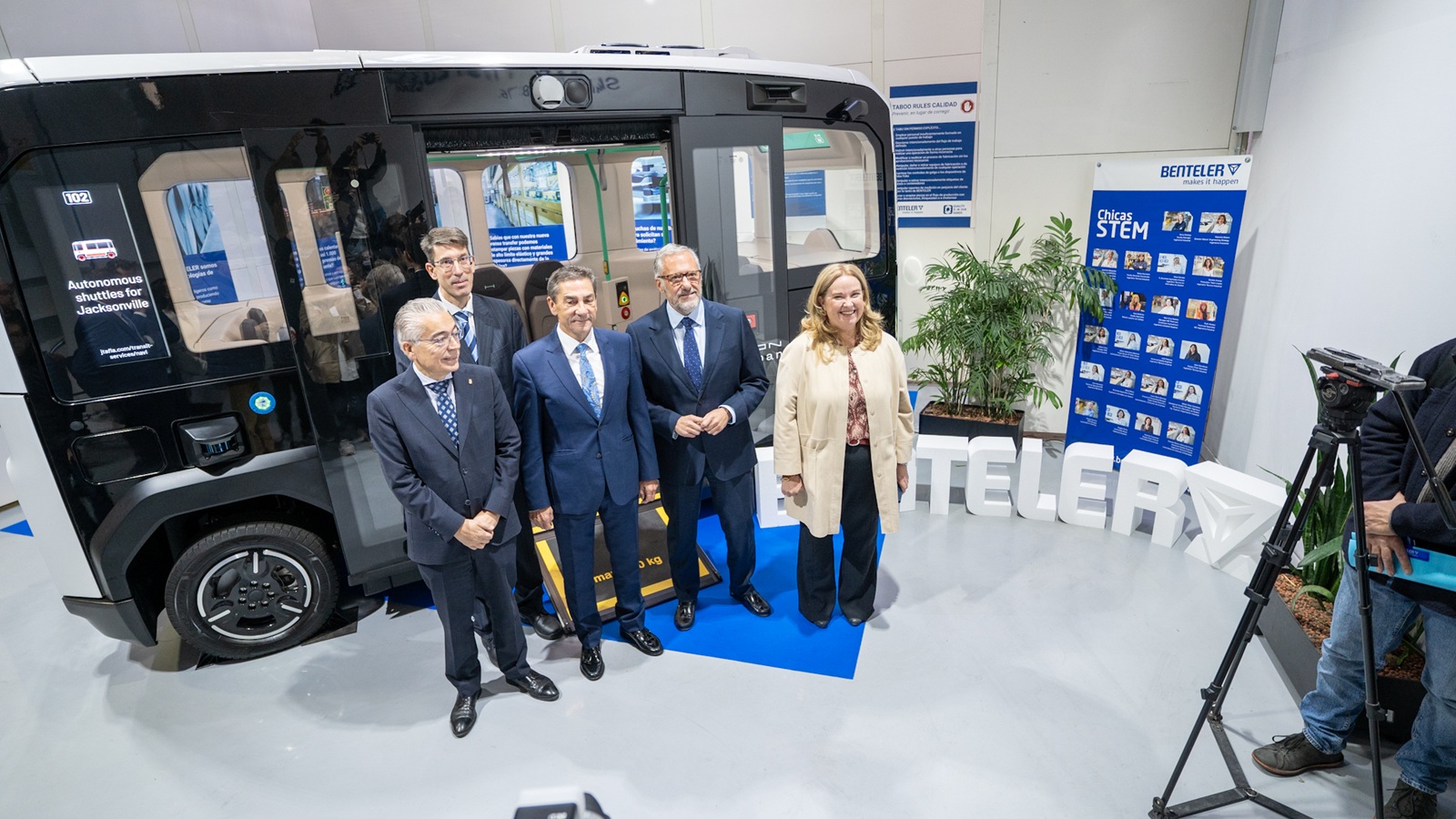
BENTELER celebrated its 150 years of history with a forward-looking view of an industry that is already transforming its factories. The company opened its Burgos plant to representatives of the region’s leading institutions of Castilla y León and the city to commemorate the milestone and show how automation, digitization, and Artificial Intelligence have already integrated into its production processes and how these technologies are contributing to improving workers’ jobs.
The event featured the participation of the First Vice President of the Junta de Castilla y León and counselor for Deregulation, Family and Social Aid, Carlos Pollán, and the mayor of Burgos, Cristina Ayala, among other authorities. During the day, BENTELER presented some of the projects in which it is applying Industry 4.0 technologies in its operations and showed how technological innovation has moved from strategy to the reality of its production centers.
According to Ricardo García, president of BENTELER Automotive Modules in Europe and Global Operations Director of the Modules Division, “Celebrating 150 years of history allows us to look back with pride, but, above all, to look forward with great confidence. Today we are showing how technologies such as Artificial Intelligence, automation and digitization are already transforming our factories and our way of working. The important thing is not only to incorporate these technologies, but to apply them in a way that has a positive impact on people, improving their working conditions, safety and well-being.”
150 years of industrial transformation
Over its 150-year history, BENTELER has progressed from a small hardware store founded in 1876 to become an international group specializing in solutions for the mobility industry. In this journey, the company has integrated new technologies and processes as the needs of its customers and society have evolved.
The anniversary has served to show how this transformation is already part of the daily life of BENTELER’s factories. The company has demonstrated that efficiency and technological innovation can go hand in hand with the well-being and professional development of people. After 150 years of industrial history, the brand has shown that the factory of the future is not only more automated and connected, but also an environment in which technology is at the service of those who work there.
During his visit, Carlos Pollán, the First Vice-President of the Junta, offered words of congratulations for the company and highlighted the region’s industrial fabric’s commitment to the current transformation process that businesses are facing, underscoring the importance of having an environment that enables innovation, growth and opportunities in the territory. “Celebrating BENTELER’s 150 years is also celebrating the value of industry and its ability to remain a protagonist in the future of our region.”
Trajectory, evolution and commitment to Burgos
The Burgos plant’s history is a highlight of the company’s trajectory. Opened in 1990, it was the first factory BENTELER built from scratch outside Germany, marking one of the early steps in the group’s international expansion. Since then, the company has expanded its industrial activity to Europe, the Americas, Asia and Africa.
Cristina Ayala, mayor of Burgos, noted that “BENTELER is part of the industrial history of our city, and celebrating its 150 years is a source of pride for all Burgaleños. These are 150 years of trajectory, evolution and commitment to an industry that has learned to adapt to major changes in the sector and to face the future without losing sight of what matters most: people and the ties to the region.
During the visit, attendees could learn how BENTELER is applying Artificial Intelligence to the design of job roles. The company has developed tools capable of analyzing the characteristics of each role to design ergonomic solutions tailored to workers’ needs. This project demonstrates how it has placed people at the center of its technological transformation, using innovation not only to optimize production processes but also to improve safety, health and well-being for those who work in its factories.
The company has also shown how automation and Artificial Intelligence have reduced repetitive tasks and enabled professionals to take on higher-value functions. At the same time, BENTELER has strengthened training and development of new skills to accompany this transformation, demonstrating how technological innovation can contribute both to improving production processes and to creating new professional development opportunities for people.
The company also shared one of its bets for the mobility of the future: the HOLON urban vehicle, an autonomous and sustainable mobility solution that attendees could experience firsthand during the visit.