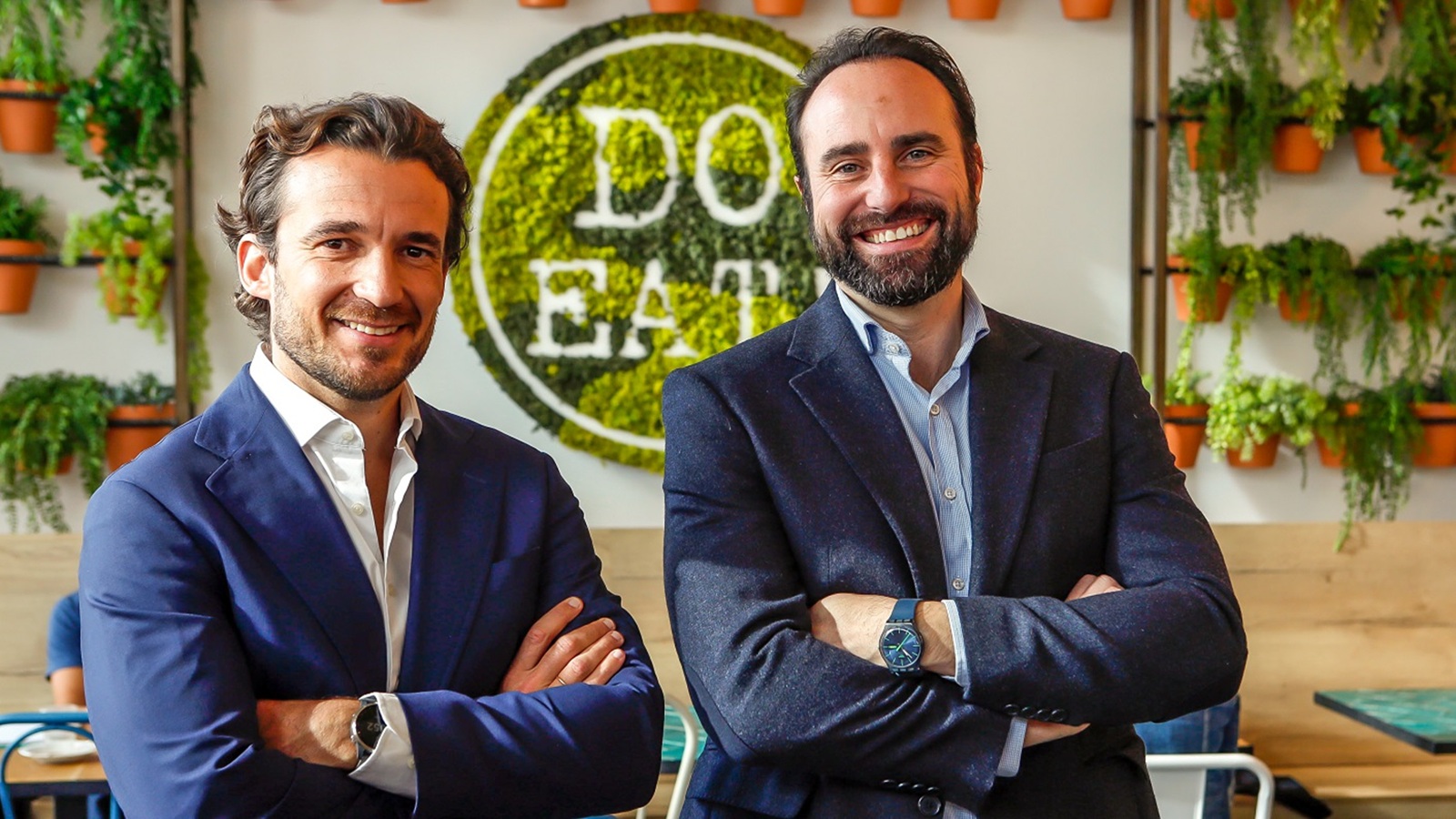
Entrepreneurship doesn’t always mean inventing a revolutionary product or developing disruptive technology. Sometimes, the best business opportunities arise from spotting the shortcomings of a service that has been operating for decades in virtually the same way. That was the premise that led Diego Pérez Crespo and Jaime Arteaga Maestre to launch DO EAT! in 2011, with the goal of changing how companies delivered food service to their employees.
The two founders identified an opportunity in traditional corporate cafeterias, a segment they believed offered room for improving the quality of the food, the customer experience, and the flexibility of the service. Their proposal was to introduce the concept of Fast&Good, based on offering fresh and healthy meals in an agile format tailored to the needs of workers and organizations.
Fifteen years later, that initiative has become a company with a presence in several autonomous communities, 45 operating restaurants and a workforce that now exceeds 500 professionals. Its revenue reaches 30 million euros, a figure that reflects the scale the project has reached since its inception.
Identifying a need and building a scalable business model
One of the elements that explains DO EAT!’s evolution is its ability to adapt the service to different spaces and consumer profiles. Rather than simply reproducing the traditional corporate dining hall model, the founders decided to develop a proposition that combines gastronomy, well-being, and operational efficiency.
“When we started fifteen years ago, our goal was to transform a dining model that we believed had enormous potential for improvement. Fifteen years later, we have managed to develop a dining model that combines culinary quality, operational efficiency, and the capacity to adapt to different market segments,” explains Diego Pérez Crespo.
This philosophy has allowed the company to progressively expand its areas of activity. What began focused on corporate environments has extended to universities, student housing, business complexes, and, more recently, sports facilities.
Diversification has thus become one of the pillars of its growth. Maintaining a recognizable proposition, but tailoring it to each client’s characteristics, has enabled DO EAT! to seize opportunities across different segments of the restaurant market.
From corporate cafeterias to new market niches
The evolution of consumer habits has also influenced the company’s strategic decisions. Increasingly, users demand healthy options, culinary variety, and pleasant spaces, even when they eat daily at work or on campus.
To respond to these needs, DO EAT! has developed different dining formats and has expanded its footprint into sectors that were not part of its original activity.
During 2026, the company took a new step by entering the gym sector and launching a service delivering freshly prepared meals. This latter service is aimed especially at companies and facilities that do not have enough employees to justify installing an on-site restaurant.
It is a strategic move that allows access to smaller clients and expands the total addressable market without relying exclusively on opening new locations.
“The restaurant sector is undergoing a significant transformation, and companies are seeking increasingly flexible, efficient solutions tailored to their needs. Our experience across segments and the strength of the model we’ve developed enable us to pursue new business opportunities and continue expanding our presence in the market,” highlights Jaime Arteaga Maestre, cofounder of the company.
New openings and major companies among its clients
The growth strategy is also reflected in DO EAT!’s latest openings. The company has recently inaugurated new dining spaces at the Porsche Ibérica headquarters, the Viding Alcántara gym, and the Yugo Palm residence in Seville.
In addition, it is preparing a forthcoming opening at the Madrid headquarters of the law firm Pérez-Llorca.
Its client portfolio includes firms such as Garrigues, Acciona, Capgemini, Openbank, Veolia, and Bristol Myers, as well as educational institutions like IE University and different operators of student residences, including Resa, Livensa Living, Xior Student Housing, and Student Experience.
This presence across different sectors allows the company to operate in markets with varying needs and consumer habits, reducing its dependence on a single client type.
The keys to a fifteen-year entrepreneurial journey
DO EAT!’s story highlights some strategies that may be of interest to other entrepreneurs: identifying an unmet need, differentiating in a mature market, designing an adaptable service, and pursuing new growth opportunities without losing the essence of the business.
Its evolution also underscores the importance of continually revisiting the business model. The service the company launched in 2011 has had to adapt to changes in eating habits, consumer expectations, and the needs of organizations.
Now, after reaching 30 million euros in revenue, DO EAT! is entering a new phase focused on continuing to grow in the segments where it already has a presence and developing formats that enable it to reach new customers.
“Today, companies are not only looking to meet their employees’ daily meals, but to offer an experience that contributes to their well-being,” say its founders.
Fifteen years after launching the project, Diego Pérez Crespo and Jaime Arteaga Maestre have managed to turn an opportunity spotted in a traditional sector into a company with hundreds of employees and a presence in multiple markets. An example of how business innovation doesn’t always mean creating something completely new, but rather finding a different way to do things and building a business that can grow around that proposition.