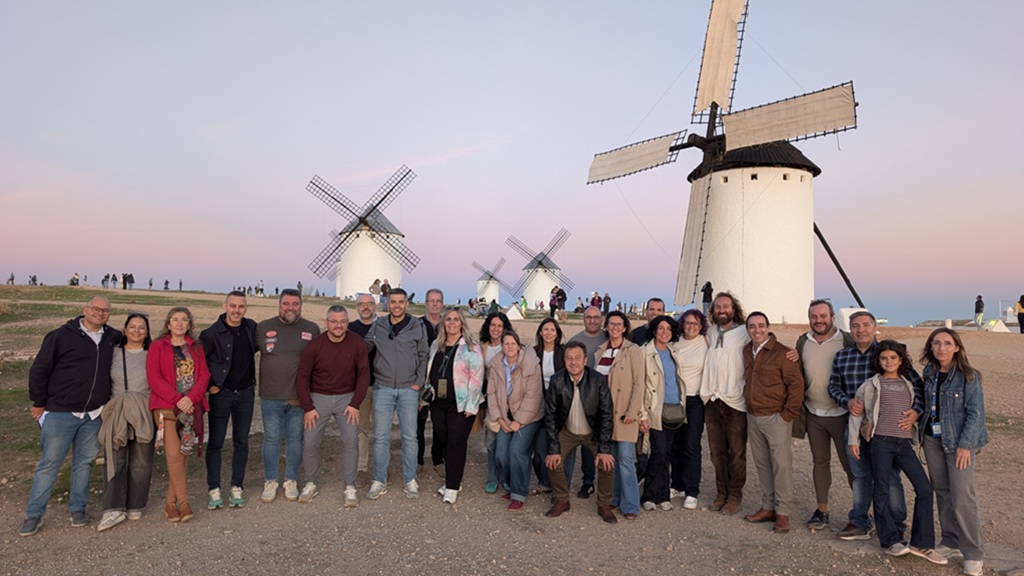
Representatives from 10 municipalities and the team of Magical Towns of Spain have identified eight work streams during the IV National Council, held in Campo de Criptana. The proposals focus on improving the economic return of tourism, strengthening cooperation between businesses and municipalities, ensuring continuity of municipal governance, and promoting opportunities for young people.
The main session was opened by Santiago Lázaro López, mayor of Campo de Criptana, and featured remarks by Francisco J. Martín, president of the Spanish Magical Ecosystem, and Noelia Guzmán, director of Magical Towns of Spain. The day addressed network governance, the evolution of Magical Companies and Magical Places, and the upcoming challenges of the Ecosystem.
During the sessions, participants shared challenges such as the involvement of the hospitality sector in certain tourism projects, the need to strengthen business associations, and the importance of ensuring the continuity of municipal technical work.
«There is something truly magical about surrounding yourself with people who understand that what matters is not individual prominence, but everything we can build together», said Francisco J. Martín.
The National Council is the advisory and strategic-working body of Magical Towns of Spain. It brings together mayors, councilors, municipal leaders, technicians, and the network team. Its role is to incorporate the municipal perspective into the evolution of the initiative, combining project reviews with the exchange of best practices.
Eight Work Streams for the Network
Municipal contributions have been gathered into eight lines of study and action. These proposals constitute a working agenda for their subsequent development and concrete implementation by the organization:
- Consolidate tourism with local returns. Connect heritage and experiences with
accommodations, hospitality, retail, and other services to promote more complete stays and a greater economic impact in the municipalities. - Strengthen public-private cooperation. Link the contacts of Magical Companies of Spain with concrete municipal projects and establish monitoring mechanisms to evaluate each collaboration.
- Pilot a working method with the Council’s municipalities. Identify needs and suitable business interlocutors and evaluate an initial call for projects before the 2027 municipal elections.
- Improve coordination and continuity of municipal management. Analyze the results of the agile-methodology pilot conducted with seven municipalities and consider more direct support for their teams.
- Capitalize on the synergy between Towns and Magical Places. Connect interest in unique enclaves with visits to the municipalities, their establishments, and their economic fabric.
- Promote rootedness, training, and youth participation. Foster educational opportunities and support youth initiatives to strengthen their involvement in the cultural, social, and economic life of their towns.
- Strengthen tourism offices and municipal technical work. Combine digital tools, personalized service, and local knowledge to promote continuity of management and a better visitor experience.
- Explore shared information systems and regional alliances. Consider common data bases, business networks, and collaboration between businesses and local development groups to leverage resources and opportunities.
Representatives from Campo de Criptana, Ayerbe, Vilaller, Arévalo, Loeches, Cabra, La Calahorra, Salas, Cambados and Belchite participated in this edition. Their contributions allowed contrasting different local realities and sharing experiences on common challenges.
Campo de Criptana and the Economic Return of Tourism
As the host, Campo de Criptana contributed a concrete example to the debate on tourism and local development. During the welcome, Santiago Lázaro López explained the municipality’s work to ensure that the appeal of the windmills translates into a greater impact on local establishments, accommodations, and businesses. The objective of moving beyond a model based mainly on brief visits aligned with promoting longer, more immersive stays and experiences.
The program combined sessions with visits to Pozo de Nieve, Casa Treviño, the caves, and the windmill surroundings. In the Sierra de los Molinos, part of the Spanish Magical Places network, participants attended a traditional milling demonstration at sunset accompanied by a wine experience from the La Mancha Denomination of Origin. The visit to Bodegas Castiblanque completed the tour of the municipality’s heritage, gastronomy, and business activity.