Finding a high-quality office in a prime Madrid location is becoming increasingly difficult. According to JLL, the city’s availability rate fell to 8.5% in Q2 2026, down from 9.1% at the end of 2025. The Grade A office supply is especially tight in the prime districts, where availability does not reach 1% and rents reach €45 per square meter per month, 8.4% higher than in the same period a year earlier.
In this scenario, the Paseo de la Castellana remains one of Madrid’s main business arteries, as firms seek spaces in established locations and, at the same time, solutions that allow them to gain adaptability as their needs evolve.
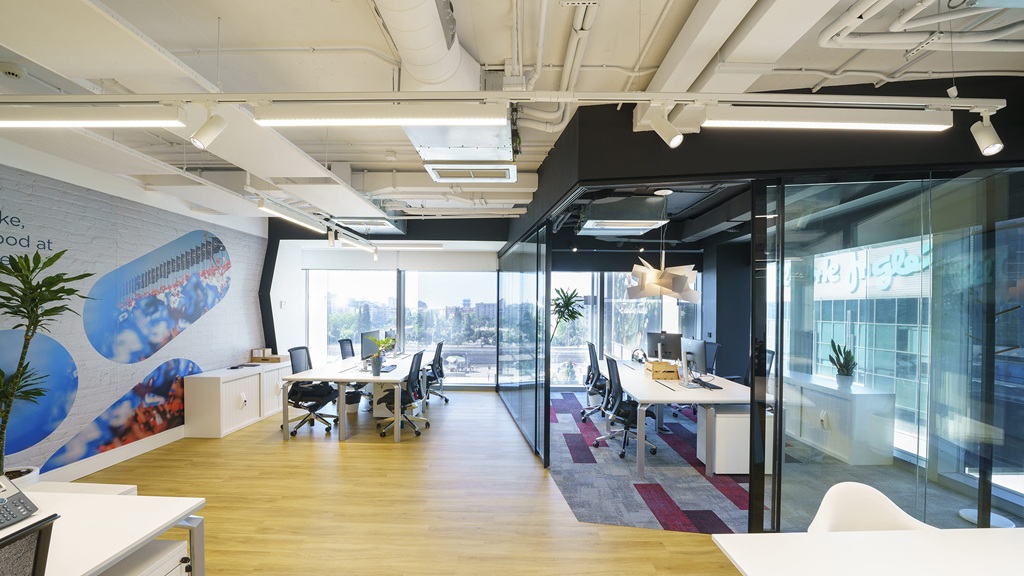
In response to this situation, Lexington will bring to market between October and December 3,500 m² of flexible offices in its flagship at Paseo de la Castellana 79. Early demand confirms growing interest in this space model: 40% of the available area is already reserved.
This availability comes after a tech giant moved into its own building, after 11 years in which it gradually expanded its footprint in Lexington—from 28 initial desks to 450 positions and nearly 4,000 m² of offices. During that time, Lexington developed for the company a fully customized corporate headquarters, tailored to its brand identity as well as its technological needs.
Flexibility Gains Ground as Space Runs Short
The evolution of the real estate market coincides with a greater prominence of flexible offices. According to the latest JLL report and the Spanish Association of Coworking (ACW), operators specializing in this type of space leased nearly 15,000 m² in Madrid during 2025, about 3% of the city’s total office leasing, which currently stands at 327,628 m² of flexible workspace and an 84% occupancy.
The same study points to a shift toward higher value-added models: brands increasingly demand customized work environments, especially private offices, without taking on the long-term commitments of a conventional lease. The Spanish flexible market is also projected to grow revenue by 15.8% in 2026.
In the words of David Vega, Lexington’s CEO, “companies no longer view the office solely in terms of square footage; they value how they will actually use the space and how it can adapt to the evolution of their teams. Growth, hybrid models, and uncertainty about future needs make the ability to scale up, down, or reconfigure an office a factor that is increasingly central to decision-making.”
Castellana, a Strategic Axis for Corporations
Lexington continues to strengthen its commitment to the corporate flexible office segment, a market that has evolved from the traditional coworking concept toward solutions aimed also at established companies seeking private, customized spaces with adaptability.
The 3,500 m² available at Castellana 79 allow the operator to respond to rising demand with a proposal aimed especially at companies needing larger corporate surfaces.
“Flexibility has stopped being an alternative to the traditional model and has become a competitive advantage. In a market with an increasingly limited supply in the best locations, that adaptability can make the difference,” concludes David Vega.