Autonomous drones that already monitor the Galician hills for wildfires; wastewater transformed into renewable gases; sea-plastic waste repurposed into materials capable of filtering contaminants; or artificial intelligence systems that improve industrial processes. These are technological developments that are solving concrete problems today, but they can evolve toward other applications able to meet future challenges: machines that operate autonomously, more efficient and self-sufficient energy models, circular economy systems for recycling materials, or AI-driven developments applied to real-world processes.
These are some of the solutions ITG, in A Coruña, is working on—one of the 60 Technology Centers affiliated with the Spanish Federation of Technology Centers (Fedit)—and an example of how research and knowledge translate into technology that businesses and administrations can apply.
“When we talk about innovation, we often focus only on doing something and putting it away in a drawer. At Technology Centers we work with companies, with the end user. We understand the need,” explains Enrique Ventas, Global Growth Director of UAS (Unmanned Aerial Systems) at ITG.
From research to real-world application
Autonomous aerial mobility is one of these areas. ITG works across the entire technological chain needed for drones to operate with an increasing degree of autonomy, from the aircraft themselves and their intelligence systems to operations automation, communications, cybersecurity and airspace management.
NIDOS is a system of robotized hangars from which a drone can take off, carry out a mission, and return autonomously, enabling 24/7 surveillance operations. Three of these systems are already deployed in the Galician hills to support wildfire surveillance, coordinated with the public fire-fighting service control center.
The center develops other drone applications to locate missing persons, detect mines and explosive devices, perform urgent healthcare transports, or autonomously land on moving surfaces, such as a ship’s deck, a technology developed in collaboration with Indra.
Another major challenge of autonomous air mobility is safely and coordinately managing airspace where hundreds of drones may operate simultaneously. ITG’s Daliah platform works as a digital, automated air traffic control system capable of handling routes, restrictions, and potential conflicts between aircraft.
The leap from research to business application is also seen in the energy and circular economy sphere. ITG and Naturgy have collaborated since 2016 on solutions related to renewable gases, including using biogas produced at the A Coruña wastewater treatment plant. The partnership has progressed toward new technologies related to sustainable mobility, renewable hydrogen, biomethane, storage, and intelligent energy management.
The challenge of decarbonizing ports is also being addressed in ITG’s labs in A Coruña. Electrification of ships while berthed remains limited: only four of Spain’s 46 ports under Puertos del Estado currently can supply shore power to docked vessels. ITG is developing solutions to generate, store, distribute, and manage that energy more efficiently.
Another project at the center starts from a problem especially tied to the region: plastics collected from the sea by Galician fishing guilds and cooperatives. ITG is working on valorizing them to obtain a carbonaceous solid capable of filtering water contaminants: for every 100 kilos of treated sea plastic, about 20 kilos of this new material can be produced, with potential applications in fish farms and seafood processing plants. The development illustrates how the circular economy can turn a waste into a new resource.
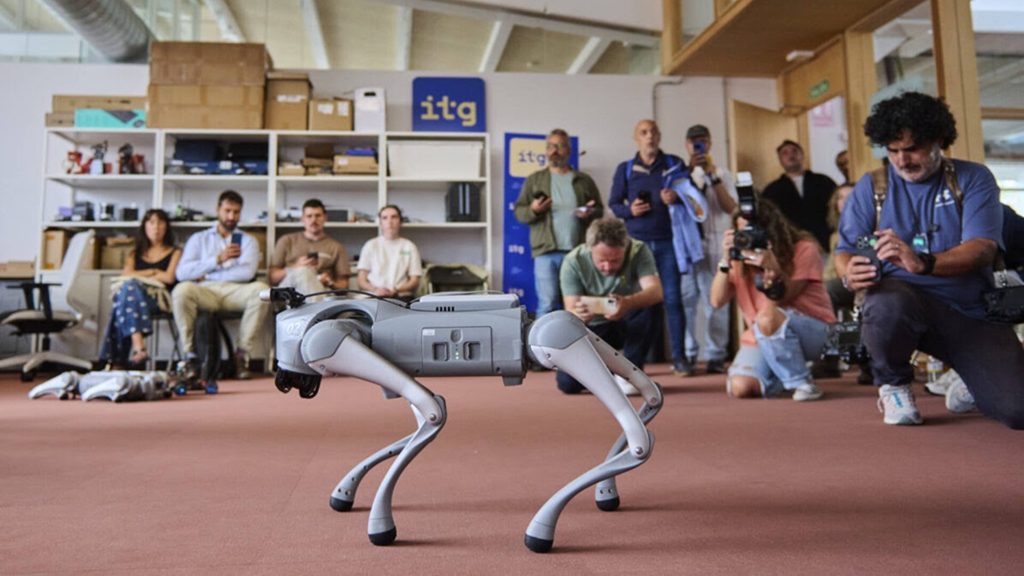
Artificial intelligence and robotics are another line of research, including robot dogs controlled with virtual reality and computer vision and AI systems capable of interpreting information, making predictions, and automating processes. For example, the Galician generator set company Genesal Energy collaborates with ITG applying AI to the industrial sector to enable predictive maintenance of its equipment and anticipate potential issues.
These examples from A Coruña illustrate the role of Technology Centers as generators and bridges between knowledge and the market. Centers affiliated with Fedit collaborate each year with about 30,000 companies, especially small and medium-sized enterprises, helping them develop new products, services, and solutions with economic and social impact.