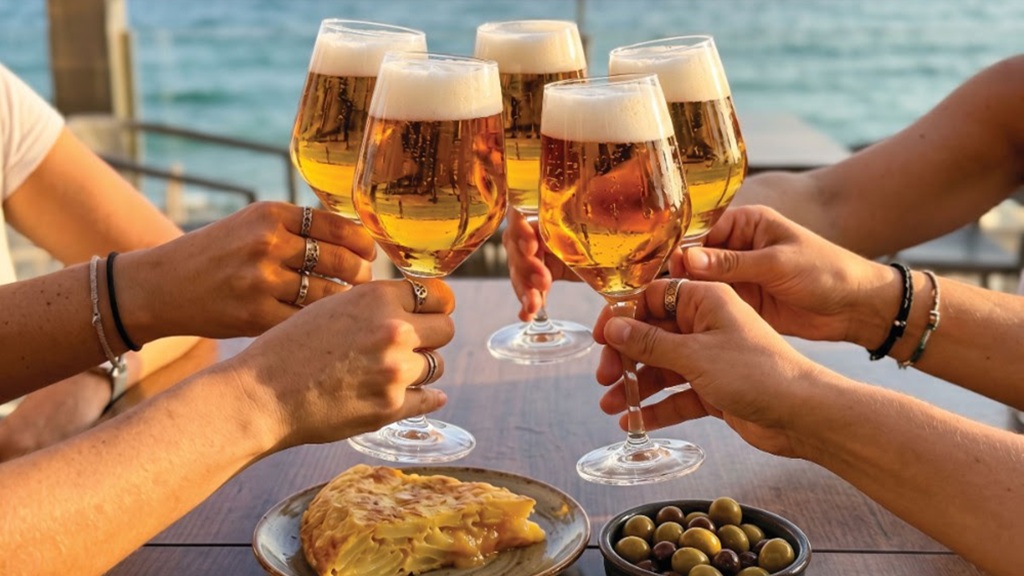
What if your next trip began and ended with a beer? Not to sit on a terrace and order a pint, but to discover where it’s brewed, what ingredients are behind it, how it has evolved, what varieties exist, which products it pairs best with, or what territory lies behind each brew.
What is zitotourism
The term, built from zythos, the ancient Greek word for beer fermented from grain, names a set of experiences that have been developing for years in Spain: visits to production centers and museums, tours of breweries, tastings, pairings, festivals, workshops, discovery of ingredients and raw materials, or routes that connect beer, gastronomy, and territory.
So it’s not about inventing a new way to travel, but about giving visibility to a tourist experience that already exists and that is still lightly recognized by the general public.
In Spain, beer is much more than a drink: it’s part of our culinary culture and our way of socializing. It’s present in gatherings with friends and family, at the aperitif, during tapas, or around a table, part of those small everyday rituals that turn eating and drinking into a shared experience.
In fact, the Spanish pattern of beer consumption is closely tied to moderation, companionship, and the accompaniment of food, in line with the Mediterranean lifestyle. According to data from Cerveceros de España, 86% of consumers enjoy beer in the company of friends or family and nearly 90% of consumption occasions occur in social and gastronomic contexts.
This social and gastronomic dimension is precisely what allows us to understand why beer can also become a way to travel and get to know every corner of Spain: behind each brew there are ingredients, people, recipes, traditions, landscapes, and a culture that forms part of the land.
A beer country with a lot to discover
Spain has a beer sector of enormous scale with more than 250 production centers and distributors spread across the country. In 2025 it produced 41.5 million hectoliters of beer, up 5.1% from 2019, and established itself as the second-largest beer producer in the European Union, only behind Germany. But the phenomenon goes far beyond production.
According to the 2025 Socioeconomic Report on the Beer Sector in Spain, prepared by Cerveceros de España together with the Ministry of Agriculture, Fisheries and Food, beer is associated with more than €5.2 billion of tourist spending in Spain. Additionally, around 30% of beer consumed in Spain is by tourists, and in 2025 tourist beer consumption in hospitality rose by 4.1%.
An impact that directly ties to the land: more than 90% of the raw materials used by the Spanish beer sector come from the national countryside, including ingredients such as malted barley and hops.
From ingredient to destination
Zitotourism reveals that behind a beer there is much more than a beverage. Visiting a production center and learning its process, discovering the origin of its ingredients, participating in a tasting, exploring its culinary possibilities, getting to know local projects or touring territories linked to its production are some of the experiences that bring you closer to beer culture from a tourism perspective.
These are experiences that are already part of the offerings of various destinations and that connect gastronomy, culture, territory, and leisure, but they still lack a widely recognized concept to group them.
That’s where zitotourism comes in: a word to identify and make more visible a way of discovering destinations through their beer culture.
An experience that already exists, but we don’t yet know what to call it
The National Institute of Statistics (INE) itself includes gastronomic tourism within trips motivated by experiences such as getting to know the cuisine of a region, visiting restaurants, conducting tastings, or taking part in gastronomic routes.
Zitotourism sits precisely in that space: a way to know a destination through one of its products, its people, its cuisine, and its territory.
And Spain has a particularly favorable context to grow it. In 2025 the country welcomed 96.8 million international tourists, who spent about €134.7 billion. The opportunity, therefore, is to turn what already exists into something more recognizable.
Because perhaps travelers aren’t looking for “beer tourism.” Perhaps they don’t know it exists yet. But they may be seeking exactly the behind-the-scenes experience. Zitotourism isn’t just about drinking beer. It’s about traveling to discover everything that lies behind it.