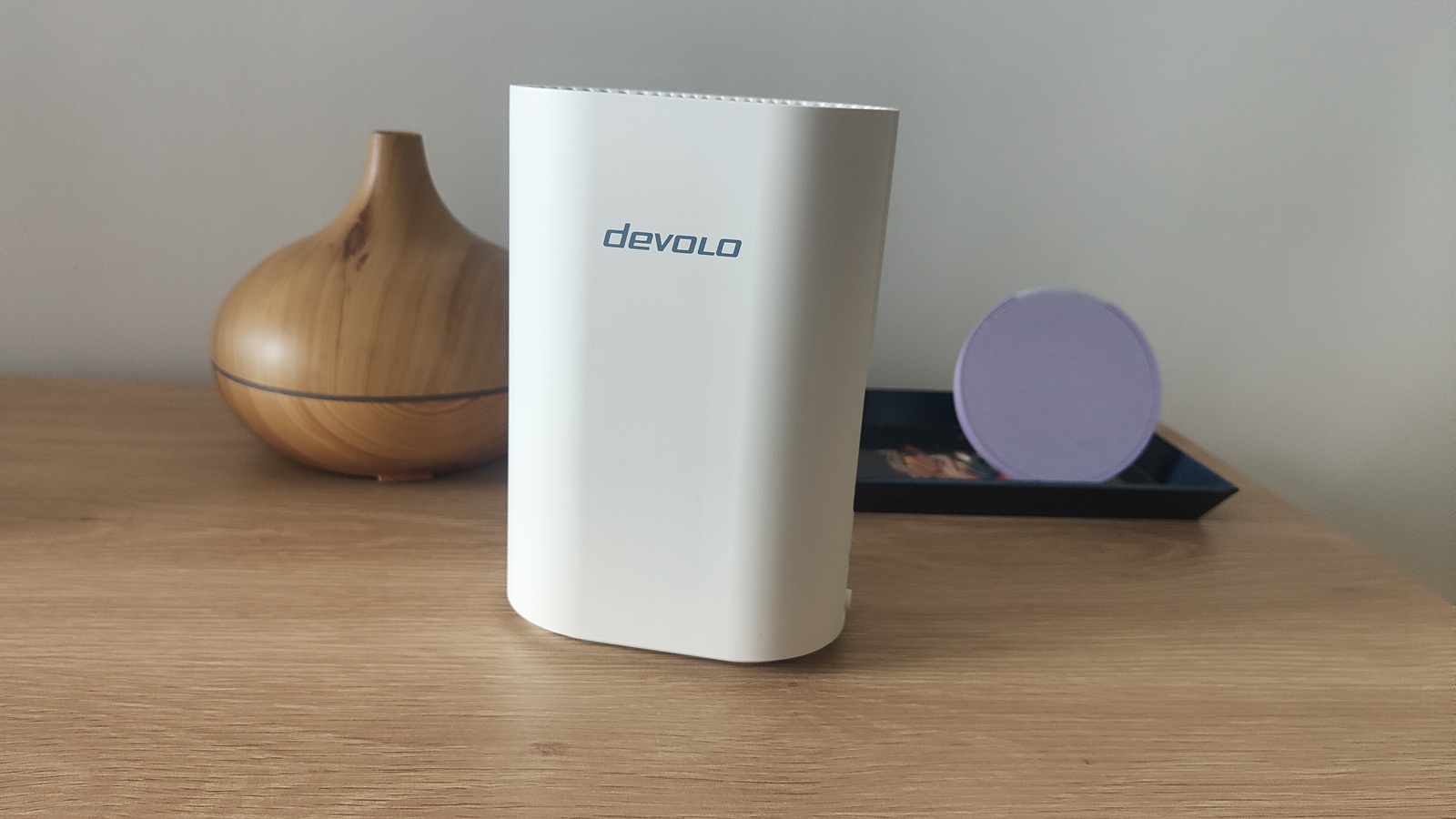
The German company is launching a solution designed to better leverage fiber-optic connections, improve coverage in large spaces, and reduce the usual issues of stability, latency, and signal dead zones.
Having fiber in the office no longer guarantees a good connection experience by itself. The subscribed speed can be very high, but if the router mis distributes the signal, if there are too many devices connected or if the building has multiple floors, thick walls, or areas far from the access point, the result is often the same: dropped video calls, buffering streaming, latency in gaming, and rooms where Wi‑Fi barely reaches.
Against this backdrop, devolo has unveiled its new Mesh WiFi 7 system and the devolo WiFi 7 BE6500 router, a proposal aimed at bringing the advantages of the new wireless standard to homes and offices that demand more from their connectivity. The German company, specialized in home networking solutions, seeks with this launch to offer a simple alternative for those who want to get more out of their fiber connection without dealing with advanced configurations.
The new devolo WiFi 7 BE6500 is designed to function as an Ethernet router for fiber connections, connected to the ONT or the appropriate modem via Ethernet cable. It can also be used as an access point or as part of a complete Mesh network, allowing it to adapt to different scenarios: from a small home that needs to upgrade its router to large offices where deploying several access points is advisable to achieve more uniform coverage.
Top WiFi 7 connection speed
The main novelty is the integration of WiFi 7, the standard that promises to improve not only the maximum connection speed but also the network’s ability to handle multiple devices at once with lower latency. In the case of the devolo WiFi 7 BE6500, the maximum wireless speed reaches 6,500 Mbps, a figure designed for environments where computers, mobile devices, smart TVs, consoles, IoT devices, and work devices are connected simultaneously.
The unit works across the 2.4 GHz, 5 GHz, and 6 GHz bands, with dual-band configurations of 2.4 + 5 GHz or 2.4 + 6 GHz, and supports channel widths up to 320 MHz. It also incorporates WiFi 7 technologies such as 4K-QAM, Multi-Link Operation, and Multi-RU Puncturing, aimed at improving throughput, efficiency, and stability of the wireless connection. For the home user, this translates to a network better prepared for heavy-duty tasks like remote work, gaming, high-resolution streaming, or transferring large files within the local network.
One of the most interesting aspects of the proposal is its Mesh approach. Rather than relying on a single router trying to cover the entire home, devolo’s Mesh system creates a network formed by multiple access points that work in a coordinated fashion. This means devices connect to the most suitable node at any moment, and users can move around the house without having to manually switch networks or experience coverage drops.
The new Mesh WiFi 7 BE6500 system will be available in two- and three-device kits designed for homes of different sizes or those with particularly tricky zones. devolo includes features such as Access Point Steering, Band Steering, bidirectional Multi-User MIMO, and OFDMA—technologies that help distribute network load more evenly, steer each device to the most suitable band, and improve performance when many devices are connected simultaneously.
Installation has also been designed so that you don’t need advanced technical knowledge. The Mesh kits arrive preconfigured and provide a near plug-and-play experience. For the router, simply connect it to the ONT or modem and complete setup from the devolo Home Network app or the web interface. From there you can manage the main network settings, switch operating modes, and tailor the solution to each home’s needs.
In terms of wired connectivity, the devolo WiFi 7 BE6500 includes a 2.5 Gbps Ethernet port that can be used as WAN or LAN, plus three Gigabit LAN ports. This combination allows you to hard-wire devices that require more stability—such as a desktop computer, a game console, a TV, or a home NAS—while the rest of your devices benefit from the wireless network.
Security is also part of the offering, with compatibility for WPA2 and WPA3, a firewall, blacklist, QoS, and guest WiFi network. devolo has also announced future software updates that will add features such as VPN, WiFi scheduling, parental controls, and an allow-list, features particularly useful in family homes or environments where more control over network use is desirable.
A solution designed for offices that have already outgrown the traditional router
devolo’s proposal is especially appealing for offices where the service provider’s router falls short. In practice, most connection issues aren’t so much about the fiber service as how that connection is distributed across the space. That’s where a Mesh solution with WiFi 7 can make a difference, especially in offices with multiple rooms, many connected devices, and users working simultaneously.
The system gives the impression of a product built to simplify a technology that, on paper, can seem complex. The setup via the app is straightforward, the devices arrive ready to work together, and the user doesn’t have to make too many technical decisions to start seeing an improvement in coverage. This is important, because many home-network solutions promise great performance but end up being less user-friendly for someone who simply wants WiFi to work well throughout the house.
In everyday use, the greatest value of the devolo WiFi 7 BE6500 isn’t just achieving very high speeds in ideal conditions, but delivering a more stable connection when the network is crowded with devices. Video calls, streaming TV, mobile devices, laptops, smart speakers, cameras, game consoles, and connected appliances all compete for the same bandwidth daily. Against that real-world usage, WiFi 7 and Mesh management provide margin, order, and capacity to make the experience smoother.
Its flexibility is also compelling. Being able to use the device as an Ethernet router, access point, extender, or full Mesh system lets you start with a simple setup and scale up later if needs change. For many homes, that scalability will be more useful than buying a oversized solution from day one. Moreover, compatibility with older WiFi devices prevents having to replace existing gear when upgrading the network.
That said, it’s important to be clear about the target user. Someone working in a small office, with few connected devices and no coverage issues, probably doesn’t need a top‑tier Mesh solution. By contrast, for large spaces, multiple floors, heavy fiber usage, many connected people, or small home offices, the new devolo system fits very well: it’s not just a speed boost, but a way to make the connection more reliable, more organized, and more ready for the years ahead.