The evolution of robotic vacuum cleaners has for years been marked by increasingly visible improvements: more suction power, better navigation, artificial intelligence, or obstacle detection. But while suctioning advanced at a rapid pace, mopping faced a far more complex problem to solve: how to clean a floor effectively without spreading dirt around during the process?
The Grand Challenge of Robotic Mopping
Unlike vacuuming, mopping involves working with water, liquid dirt, and stubborn stains. For years, most robots relied on damp mops that, as they picked up dirt, continued to pass over other areas of the home. Solving this challenge required rethinking completely how a robotic system interacts with the floor.
With this idea in mind, ECOVACS developed OZMO, a technology designed to intelligently manage water usage during cleaning. Its goal was clear: to control when, where, and how much water to use to improve mopping effectiveness.
The real leap came when the company challenged one of the industry’s core principles: the use of passive mops.
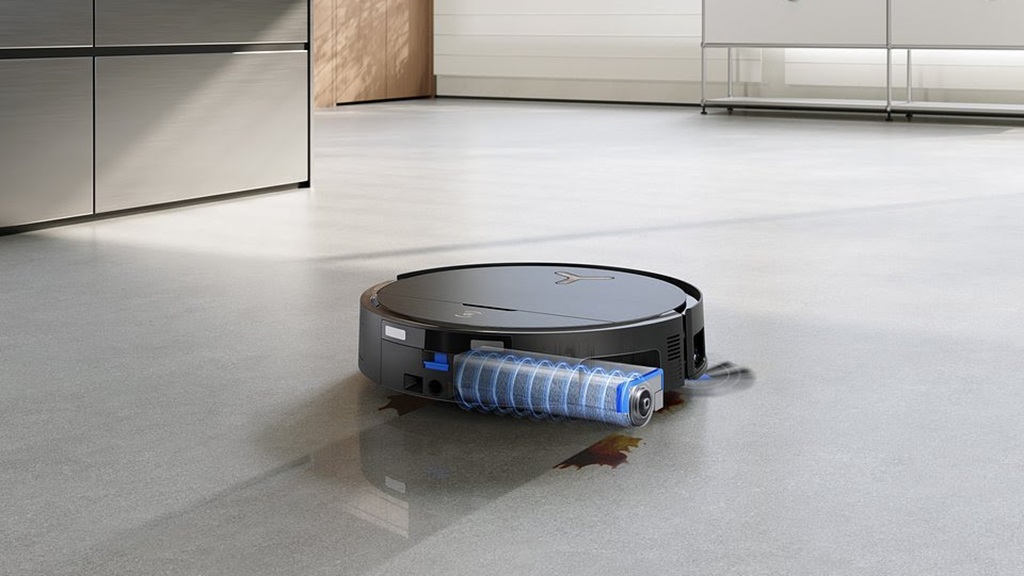
In September 2024, the company unveiled the DEEBOT X8, the first vacuum robot on the market equipped with the patented OZMO ROLLER Constant-Pressure Active Water Mopping technology, becoming the first brand to introduce a mopping system with an actively rotating roller under constant pressure.
While traditional systems rely on textile surfaces that slide over the floor, OZMO ROLLER features a roller that continuously spins while receiving clean water and removing dirty water in real time. The result is a more consistent cleaning and a reduced likelihood of redistributing dirt throughout the home.
Why Does Pressure Matter So Much?
One of the most interesting aspects of OZMO ROLLER’s development is that ECOVACS did not focus solely on increasing pressure, but on how to apply it.
The logic is similar to removing a stubborn stain with a cloth: focusing force on a specific area tends to be more effective than spreading it over a wide surface. Translated to home robotics, this means that the intensity of pressure can be more important than the total pressure applied when removing embedded stains.
The latest generations of the technology incorporate continuous self-cleaning of the roller while the robot is operating. In OZMO 3.0, an active water-distribution network with 32 channels and a constant-pressure scraper remove residual water while the roller spins and self-cleans continuously at speeds of up to 220 rpm, helping to keep the cleaning surface clean throughout the process.
The advances developed over the years around OZMO are already finding practical applications in ECOVACS’ latest robot lines.
The story of OZMO reflects a growing trend in household robotics: innovation is no longer about simply adding more power or more features, but about solving everyday problems that for years seemed inevitable.
If the first generation of robotic vacuums focused on picking up dust, the new generation aims to answer a far more ambitious question: how to autonomously replicate something as complex as cleaning a floor effectively.