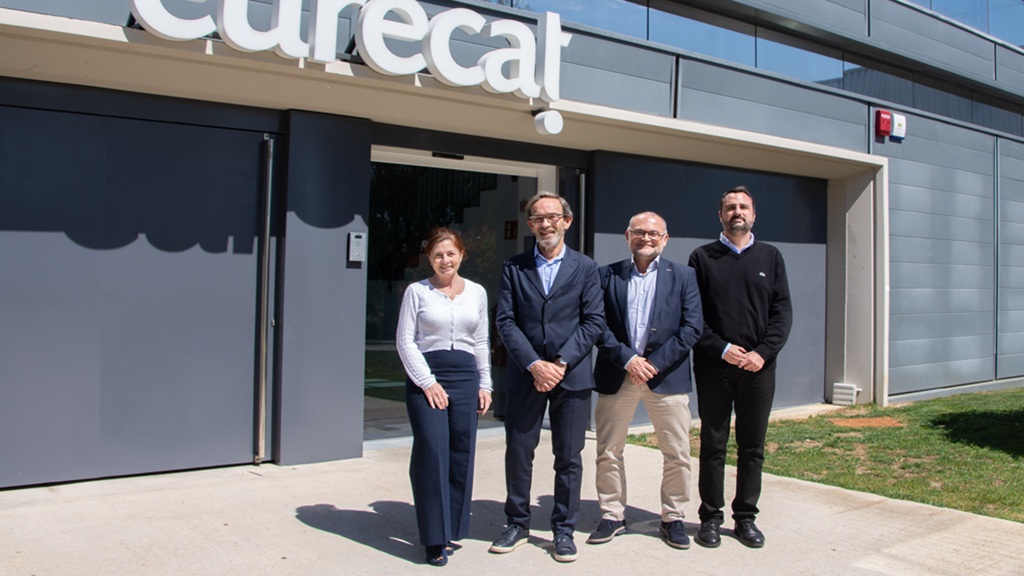
The Eurecat technology center has begun the deployment of QuantIA Lab, a new infrastructure for quantum emulation and optimization, unique in Catalonia, to accelerate R&D&I across the business ecosystem and tackle real industry challenges through advanced quantum computing and artificial intelligence technologies.
The new facility will be located at the center’s headquarters in Cerdanyola del Vallès and will be rolled out progressively, with completion expected by early 2027. The project represents an investment of more than €7 million, of which €1.4 million comes from the Institutional Singular Grants program of the Department of Research and Universities of the Generalitat de Catalunya and €2.1 million co-financed by the European Union through the European Regional Development Fund (ERDF) for Catalonia 2021-2027, via the Quant-IA project.
In the framework of QuantIA Lab, Eurecat will be able to accompany business innovation in solutions based on quantum computing thanks to a 34-qubit quantum gate emulator and a digital annealer, complemented by a high-performance computing cluster. With this new equipment, Eurecat “is taking a leap in the research and transfer of quantum technologies to companies, to support them in developing real pilots and achieving tangible competitive advantages”, emphasizes Myriam García-Berro, Eurecat’s Director of Research and Technology.
According to Adan Garriga, the principal investigator of Eurecat’s Quantum Computing Research Line, the QuantIA Lab “will complement the services of the center’s multidisciplinary team, which already combines knowledge of quantum physics, artificial intelligence, and software development.” The objective is to offer the business fabric “a safe and stable environment to experiment and validate quantum algorithms, and prepare for the moment when quantum computers are fully operational and have achieved quantum advantage due to a drastic reduction in computation time or a decrease in related costs.”
Unlike real quantum systems, which require cryogenic temperatures and present stability challenges, “the two emulation assets of the QuantIA Lab will be implemented with semiconductor processors. This will enable the equipment to operate under conventional environmental conditions, without coherence errors and with comparatively much lower operating costs,” adds the Scientific Director of Eurecat’s Digital Area, Joan Mas.
In addition, the infrastructure is planned to be powered by renewable energy, thanks to photovoltaic panels and storage systems to increase energy efficiency.
State-of-the-art equipment for quantum simulation
The 34-qubit gate emulator will enable simulating the behavior of quantum circuits through classical electronics under standard operating conditions, a challenge that current quantum computers—relying on physical qubits—have not yet managed to overcome. This asset “will facilitate the design, validation, and optimization of quantum algorithms and Quantum Machine Learning before running them on a real quantum computer, reducing costs, risks, and development times,” notes Adan Garriga.
This simulation capability will be complemented by a digital annealer, capable of solving combinatorial optimization problems with up to 100,000 variables. This technology, unique in Catalonia, will make it possible to tackle challenges beyond the reach of conventional classical computing, such as industrial planning, complex logistics optimization, investment management, molecular simulation, or the design of new materials, among others.
All of this infrastructure will be complemented by a high-performance computing cluster, which will act as the engine to support projects in advanced artificial intelligence and big data processing, as well as projects that require hybrid solutions based on quantum simulation and high-performance computing.
Acceleration of multisector innovation
The QuantIA Lab technologies at Eurecat will have multisectoral impact, with notable emphasis on health and biotechnology, where fields such as molecular simulation, drug discovery, and complex genomic analysis will be advanced.
They will also drive progress in chemistry and advanced materials, for optimizing synthesis processes and tailor-made materials; in robotics and manufacturing, for industrial planning, plant logistics, and the automation of complex processes; in energy, with smart grid management, resource optimization, and sustainable routing, and in water and the environment, for optimization of distribution networks, plant management, and climate-prediction modeling, among others.