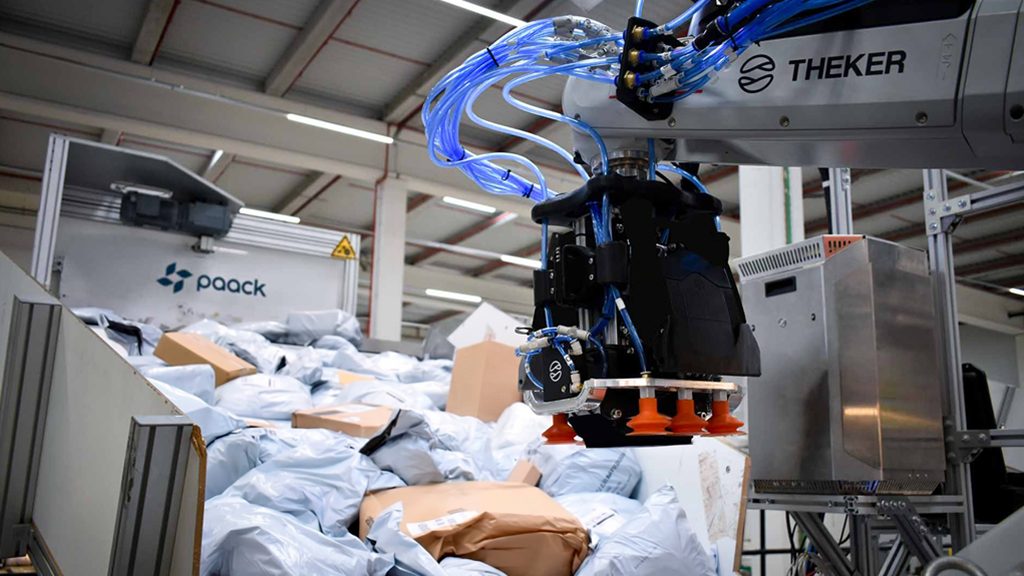
Paack and THEKER have allied to implement THEKER’s automation solutions applied to Paack’s logistics operations. As part of this partnership, the two companies have launched the first production deployment of a robotic cell powered by artificial intelligence capable of fully automating the induction of completely heterogeneous packages without human intervention.
Thanks to this, the solution is now operational in a real-world setting at the San Fernando de Henares logistics center, with an initial goal of completing the installation of several units at this site and, in parallel, scaling the model to other hubs such as Barcelona, where the first robot is already in the testing phase.
Full automation in the most complex phase of the supply chain
For the first time, a robotic system enables the automation of the heterogeneous package induction phase in a real production environment. Until now, this process required human intervention due to the high variability of packages in shape, size, orientation, and weight, and the complexity of coordinating with automated systems.
The solution is the result of a joint development that combines the operational know-how of last-mile logistics with THEKER’s expertise in advanced robotics and autonomous systems. Within this framework, the development integrates AI-based vision systems and autonomous decision-making capabilities that allow for real-time identification, handling, and feeding of packages, dynamically adapting to the conditions of the logistics operation.
This advance marks a step forward toward more autonomous, efficient operations and readiness for demanding, high-throughput environments.
A deployment designed to scale across the logistics network
The system has been designed to integrate natively into Paack’s operations, with no need for additional layers, and to synchronize in real time with the rest of the logistics infrastructure. Beyond a point deployment, this project is part of an innovation model based on technology partnerships that enables the rapid, scalable adoption of advanced solutions aligned with real-world operations.
The solution is designed to be replicated across multiple stations and logistics hubs, enabling agile and scalable deployment across the company’s network.
“In THEKER we develop technology to solve challenges that until recently seemed impossible. This use case with Paack marks a new milestone in that journey and demonstrates that autonomy applied to complex logistics operations is no longer a promise; it is an operational reality,” adds Albert Badias, THEKER’s Operations Lead.
The adoption of these kinds of solutions enables optimizing key warehouse processes and moving toward more predictable, scalable operations that adapt to ecommerce demand peaks.
Additionally, this solution helps make warehouse operations more efficient by reducing the burden of repetitive and physically demanding tasks, and placing people at the center by supporting their progression toward higher-value roles, professional development, and upskilling.